
The Ultimate Guide to Getting Your Project Management Certification in Saudi Arabia: All You Need to Know in 2026-2027
Saudi Arabia is one of the most demanding project markets in the world because delivery is tied to national transformation, infrastructure pressure, procurement discipline, contractor coordination, and executive visibility. A certificate helps you enter the conversation, yet your real edge comes from proving you can control scope, cost, risk, vendors, schedules, and stakeholders across high-pressure environments. That is why your Saudi certification plan should connect PMP exam domains, project initiation terms, project risk management, and stakeholder engagement from day one.
1. Why Project Management Certification Matters in Saudi Arabia in 2026-2027
Saudi Arabia’s project environment rewards professionals who can turn ambition into controlled execution. Vision 2030’s official project portfolio includes major initiatives such as Qiddiya, ROSHN, Riyadh Art, Sports Boulevard, New Murabba, and Saudi Downtown Company, which signals a market where delivery capability matters across construction, tourism, culture, real estate, technology, logistics, and public-sector transformation. In that environment, a project manager needs more than a badge. Hiring panels want to hear confident language around procurement terms, contract management terminology, critical path method, and project reporting best practices.
The 2026-2027 window is especially important because Saudi Vision 2030’s 2025 annual report says the Kingdom is moving into the third phase in 2026, with focus on sustaining momentum and delivery against national priorities. For candidates, that means employers will value people who can handle schedule compression, contractor performance, budget exposure, stakeholder escalation, and benefits tracking. A PM who understands schedule compression terms, cost management terms, resource allocation software, and dashboard tools can speak directly to the pressure Saudi employers face.
The Public Investment Fund describes its giga-projects as transformative developments including NEOM, Qiddiya, ROSHN, and Diriyah, with these projects shaping a sustainable and diversified economy. That creates a practical career lesson: your certification should match the sector you want. Construction and infrastructure candidates need stronger construction project management software, project budgeting terms, vendor management language, and RFP, RFQ, and RFI terms. ICT and transformation candidates need Agile project management tools, Scrum roles, Kanban software, and project management APIs.
The biggest mistake is choosing a certification because everyone around you mentions the same acronym. Saudi Arabia has several project lanes: giga-projects, oil and gas, utilities, construction, IT, cybersecurity, government transformation, healthcare, education, logistics, hospitality, and events. Each lane rewards a different proof stack. A civil delivery role may care about baselines, variations, claims, HSE interfaces, and contractor reports. A PMO role may care about portfolio dashboards, governance packs, benefits, and escalation discipline. A digital role may care about release planning, change adoption, integrations, and backlog clarity. Build your certification plan around quality management terms, issue tracking software, communication techniques, and conflict resolution terms.
| Saudi Career Target | Best Certification Lane | Proof Asset to Build | Hiring Panel Signal | APMIC Resource |
|---|---|---|---|---|
| Entry PM coordinator | CAPM or foundation PM training | Action log, meeting notes, small risk log, weekly status sample | Understands project language before taking ownership | CAPM prep resources |
| Assistant project manager | CAPM, PRINCE2 Foundation, or PMP prep route | Mini project charter, stakeholder list, schedule snapshot, issue tracker | Can support delivery with discipline and documentation | Project initiation terms |
| Experienced PM | PMP | Three project case studies covering scope, schedule, cost, risk, and outcome | Can lead projects across predictive, Agile, and hybrid settings | PMP exam domains |
| Government transformation | PRINCE2 Practitioner plus PMP or governance evidence | Steering pack, RACI, benefits register, decision log | Can manage approvals, audit trail, and controlled escalation | PRINCE2 vs PMP |
| Giga-project delivery | PMP, PMI-CP, PRINCE2, or advanced PM training | Baseline schedule, contractor report, change register, dependency map | Can handle scale, contractors, approvals, and shifting priorities | Construction PM tools |
| Construction PM | PMI-CP, PMP, or PRINCE2 | Critical path view, site constraint log, variation tracker, handover checklist | Can protect time, cost, quality, and contractor coordination | Critical path terms |
| Oil and gas projects | PMP plus risk, safety, and contract evidence | Interface register, risk treatment plan, procurement schedule, escalation notes | Can manage complex technical dependencies | Risk management glossary |
| Utilities and infrastructure | PMP, PRINCE2, PMI-CP | Milestone recovery plan, stakeholder approvals, cost forecast, vendor scorecard | Can manage essential-services delivery pressure | Budgeting terms |
| ICT project manager | PMP, Agile, Scrum, or PRINCE2 | Release roadmap, backlog report, dependency log, testing readiness pack | Can translate technical work into business-controlled delivery | Agile tools |
| Cybersecurity PM | PMP plus cybersecurity project knowledge | Control rollout plan, risk register, incident-readiness tracker, stakeholder map | Can coordinate security delivery without losing governance | APT mechanisms |
| Scrum team delivery | Scrum certification plus CAPM or PMP | Sprint metrics, impediment log, backlog refinement notes, release summary | Can support product and engineering teams with delivery rhythm | Scrum roles |
| Waterfall projects | PRINCE2, PMP, or formal PM training | Stage gate plan, acceptance criteria, change approvals, closeout report | Can run sequential delivery with controlled governance | Waterfall software |
| Hybrid delivery | PMP plus Agile or Scrum | Hybrid roadmap connecting milestones, sprints, risks, and dependencies | Can keep executives and delivery teams aligned | Kanban software |
| Procurement-heavy PM | PMP, PRINCE2, contract-focused training | RFP calendar, evaluation matrix, SOW checklist, vendor risk log | Can protect procurement timelines and commercial clarity | RFP/RFQ/RFI terms |
| Vendor management | PMP, PRINCE2, or supplier-management training | Supplier scorecard, SLA tracker, escalation log, contract variation tracker | Can manage outside partners with evidence and control | Vendor management terms |
| PMO analyst | CAPM, PMP, PRINCE2 Foundation, dashboard training | Portfolio dashboard, RAID summary, reporting calendar, governance checklist | Can convert project noise into useful visibility | Reporting analytics tools |
| PMO manager | PMP, PRINCE2 Practitioner, PgMP, PMO training | Governance model, prioritisation scorecard, benefits tracker, lessons learned library | Can standardise delivery without blocking speed | Dashboard tools |
| Program manager | PgMP, PMP, advanced PM training | Benefits map, dependency portfolio, transition plan, executive risk summary | Can coordinate linked projects against strategic outcomes | Top PM terms |
| Portfolio roles | PfMP or executive PM training | Investment view, capacity heatmap, prioritisation model, benefits dashboard | Can choose and sequence the right work | Workforce management software |
| Healthcare PM | PMP, PRINCE2, CAPM, Agile foundation | Clinical stakeholder map, rollout plan, privacy risk notes, change impact log | Can deliver change in sensitive operational environments | Conflict resolution terms |
| Education projects | PRINCE2, CAPM, PMP | Academic calendar map, adoption plan, stakeholder register, training schedule | Can manage institutional timing and adoption pressure | Education PM software |
| Event delivery | CAPM, PRINCE2 Foundation, PMP | Run sheet, supplier plan, go/no-go checklist, contingency map | Can control fixed-date delivery with moving parts | Event PM tools |
| Small business PM | CAPM or practical PM software training | Simple charter, task board, budget tracker, client update template | Can bring structure without enterprise overhead | Trello vs Basecamp |
| Resume gap | CAPM, PRINCE2 Foundation, or portfolio-first route | Three mini case studies showing scope, risk, issue, stakeholder, and result | Can prove capability despite unclear job titles | CAPM mistakes |
| Exam anxiety | CAPM, PMP, or PRINCE2 with mock-exam sprint | Weak-domain tracker, timed mock log, scenario-answer journal | Can prepare with structure instead of panic reading | PMP exam mistakes |
| Promotion case | PMP, PRINCE2 Practitioner, or advanced PM training | Before/after performance story, savings evidence, delivery recovery proof | Can connect certification to business value | PRINCE2 career benefits |
| Renewal planning | PMP, CAPM, PRINCE2, or continuous CPD route | PDU/CPD calendar, learning log, contribution tracker, evidence folder | Can keep credentials active and skills current | PMP renewal guide |
| Career switcher | CAPM, PRINCE2 Foundation, or PMP when eligible | Transferable-skills map from operations, engineering, finance, admin, or IT | Can explain the move with delivery logic | PMP success stories |
2. Which Project Management Certification Should You Choose in Saudi Arabia?
Choose PMP when you already have real project leadership experience and need a credential that travels across sectors. PMI lists three PMP eligibility routes: candidates with a secondary diploma need 60 months leading and managing projects plus 35 hours of project management education; candidates with a bachelor’s degree need 36 months; candidates with a GAC-accredited degree need 24 months. PMP is especially useful in Saudi Arabia when your resume already shows delivery pressure, sponsor communication, procurement involvement, and risk ownership. Build the surrounding proof with PMP exam resources, PMP mistake avoidance, project scheduling terms, and project reporting software.
Choose CAPM when you are early in your career, moving from engineering support, admin, operations, quality, IT support, procurement, or site coordination into formal project work. PMI lists CAPM eligibility as a secondary degree plus at least 23 hours of project management education before the exam, and PMI’s CAPM page also lists Arabic among the exam languages. That Arabic availability matters for Saudi candidates who want global project language while still reducing exam friction. CAPM becomes stronger when paired with CAPM exam-day survival tips, CAPM career advancement, project initiation basics, and team communication platforms.
Choose PRINCE2 when your target role sits inside government, PMO, consulting, large enterprise, controlled-stage delivery, or vendor-heavy environments. PeopleCert lists PRINCE2 Foundation renewal every three years with 60 CPD points needed for renewal, while PRINCE2 Practitioner also shows 60 CPD points and requires a prior eligible certification such as PRINCE2 Foundation, PMP, CAPM, PMQ, or IPMA credentials. In Saudi Arabia, PRINCE2 can help when your work depends on business cases, approval gates, tolerances, exception reporting, and governance cadence. Strengthen it through PRINCE2 renewal guidance, PRINCE2 exam pitfalls, stakeholder terms, and communication terms.
Choose PMI-CP or construction-specific training when your target work involves built environment delivery, infrastructure, real estate, utilities, transportation, or major development programs. Choose Agile or Scrum when your target employer is delivering systems, platforms, digital services, cybersecurity rollouts, apps, ERP, cloud migration, data platforms, or product-led change. Choose a PMO or portfolio route when your work is more about governance, reporting, prioritisation, and benefits. The point is matching the certificate to the pressure. A Saudi construction PM should speak critical path method, cost management, procurement management, and contract lifecycle management. A Saudi ICT PM should speak Agile tools, Scrum platforms, Kanban software, and project APIs.
3. The Saudi Arabia Certification Roadmap: From Eligibility to Job-Ready Proof
Start by identifying the project environment you want to enter. Riyadh-based government transformation roles often reward governance, stakeholder mapping, executive reporting, and procurement documentation. Eastern Province roles may lean toward energy, industrial, utilities, maintenance, shutdowns, and contractor interfaces. Jeddah and Red Sea corridor roles may involve tourism, hospitality, logistics, events, construction, and commercial coordination. This location-and-sector view helps you choose between PMP, CAPM, PRINCE2, Agile, Scrum, PMI-CP, or PMO training. Your study plan should include Gantt chart terminology, schedule compression terms, risk identification terms, and quality management terms.
Next, build a proof folder before you start applying. Add a one-page project summary, a stakeholder map, a RAID log, a change request example, a schedule snapshot, a budget variance explanation, and a weekly report sample. For confidentiality, anonymise names, values, and client details. The goal is to prove how you think. A Saudi hiring panel wants to see whether you can bring order to cross-functional pressure, supplier delays, authority approvals, executive questions, and handover deadlines. That proof becomes stronger when supported by project reporting terms, issue tracking software, vendor management terms, and contract management terminology.
Then create a 10-week execution plan. Weeks 1 and 2 should diagnose eligibility, target roles, weak domains, and certification choice. Weeks 3 to 5 should cover scope, schedule, cost, risk, stakeholders, procurement, governance, quality, resources, and communications. Weeks 6 and 7 should focus on scenario questions, because Saudi projects often require judgment under schedule pressure and sponsor visibility. Weeks 8 and 9 should focus on mocks, resume rewriting, and proof-asset completion. Week 10 should prepare interviews, LinkedIn positioning, and salary conversations. Use PMP exam prep resources, CAPM prep tools, PRINCE2 provider reviews, and project templates to avoid random studying.
Engineering candidates should also check whether their target role needs professional engineering registration alongside PM certification. The Saudi Council of Engineers states that professional registration requires an engineering qualification, agreement signing, necessary documents such as ID, border number, passport, or academic record, and membership fee payment; its professional accreditation guide defines rules for engineering and architectural professions. For construction and engineering PMs, this can matter because PMP or PRINCE2 proves project management capability, while engineering registration addresses professional engineering practice. Keep both lanes clean by studying procurement terms, cost terms, critical stakeholder terms, and construction PM tools.
4. Best Certification Routes by Saudi Career Goal
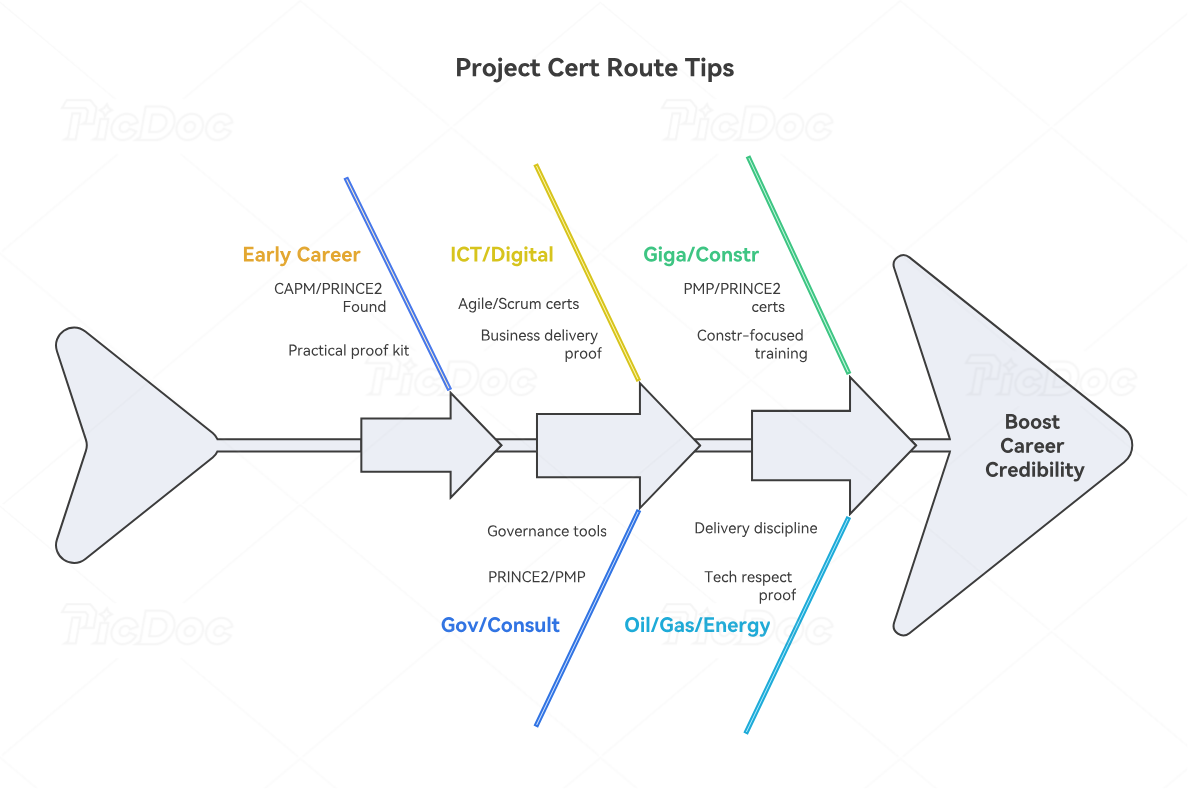
For giga-projects, infrastructure, and construction, choose a route that proves you can manage complexity at scale. PMP gives broad leadership credibility. PRINCE2 gives governance structure. PMI-CP or construction-focused training adds built-environment relevance. Your resume should show baseline management, delay recovery, contractor coordination, quantity/cost awareness, HSE interfaces, approvals, variations, handover, and reporting cadence. A certificate without these proof points will feel thin. Pair your route with construction PM software, critical path method terms, project cost management, and procurement management tools.
For oil and gas, energy, utilities, and industrial projects, the stronger profile is technical respect plus delivery discipline. You need to show control over interfaces, permits, shutdown windows, contractors, procurement lead times, risk treatments, quality checks, and executive reporting. PMP is useful when you already lead cross-functional delivery. PRINCE2 helps when governance and decision gates are central. Specialist training helps when the role demands deep sector vocabulary. Make your proof sharper with risk identification terms, quality management terms, contract management terminology, and project reporting best practices.
For ICT, digital transformation, cybersecurity, ERP, cloud, and AI-enabled projects, the certification route should prove business delivery and technical coordination. PMP supports hybrid leadership. Scrum supports product delivery. Agile supports changing requirements. PRINCE2 supports governance and controls. The proof should include release plans, user adoption, data migration, dependency management, testing readiness, stakeholder sign-offs, service transition, and benefits tracking. This route becomes more credible with Agile project management tools, Scrum tools, project management integrations, and cybersecurity mechanism knowledge.
For government transformation, PMO, consulting, and enterprise governance, your value comes from clarity. PRINCE2 is a strong match for controlled-stage language, while PMP adds broader delivery credibility. A PMO candidate should build a dashboard sample, RAID template, governance calendar, status reporting pack, prioritisation model, and lessons learned register. A consulting candidate should build before-and-after business cases, stakeholder heatmaps, benefits maps, and implementation roadmaps. Support the route with stakeholder engagement, dashboard visualisation tools, project reporting analytics, and communication techniques.
For early-career candidates, CAPM or PRINCE2 Foundation can create a cleaner entry path, especially when your job title currently says coordinator, engineer, analyst, administrator, site support, procurement assistant, operations executive, or business support. Your strongest move is building a practical proof kit: one charter, one schedule, one risk log, one stakeholder map, one weekly report, and one lessons learned page. That makes your certification visible as applied skill. Start with CAPM prep resources, CAPM career guidance, project initiation terminology, and team-building terminology.
5. Cost, Renewal, Salary Positioning, and a 90-Day Saudi PM Action Plan
Cost should be judged by career fit, recognition, renewal burden, and evidence value. PMP may be worth the effort when you meet eligibility and want senior credibility. CAPM can be a practical investment when you need foundation recognition. PRINCE2 can make sense when your target roles mention governance, business case, stages, and controls. Construction-focused routes make sense when your work depends on contractors, site milestones, claims, variations, and handover. Before paying, compare your target job ads against PMP resources, PRINCE2 training provider reviews, CAPM exam mistakes, and PM templates.
Renewal planning should begin before the exam. PMI states PMP candidates can take the exam at a Pearson VUE testing center or online and may attempt the exam up to three times in one year after paying and scheduling. PMI’s CAPM page says candidates can take the exam at a Pearson VUE testing center or online and may attempt it up to three times in one year. PeopleCert’s PRINCE2 pages show CPD-based renewal requirements, so candidates should track learning, contribution, workplace application, and professional development. Build your renewal rhythm with PMP PDU guidance, PRINCE2 recertification guidance, CAPM renewal requirements, and project reporting terms.
Salary positioning in Saudi Arabia depends on sector, employer type, experience, language ability, location, nationality requirements, technical background, and whether the role sits in delivery, controls, PMO, consulting, or program leadership. The stronger salary story connects certification to measurable business value: fewer overruns, cleaner governance, faster escalation, stronger contractor control, better reporting, lower delivery ambiguity, and improved stakeholder confidence. That means you should prepare examples around budgeting terms, schedule compression, vendor management, and issue tracking before any compensation conversation.
Your 90-day action plan should be direct. In days 1-15, collect Saudi job ads and mark repeated requirements: PMP, PRINCE2, Primavera, MS Project, Jira, risk, procurement, PMO, reporting, Arabic-English communication, contractor coordination, or stakeholder engagement. In days 16-30, choose one certification and one sector lane. In days 31-60, study, create proof assets, and rewrite your resume. In days 61-75, complete mocks, strengthen interview stories, and build LinkedIn visibility. In days 76-90, apply selectively and track response quality. Use Gantt chart terms, project scheduling terms, resource allocation tools, and small-business PM software to make the plan practical.
6. FAQs About Project Management Certification in Saudi Arabia
-
The best certification depends on your role target. PMP is powerful for experienced project managers across construction, oil and gas, ICT, consulting, PMO, and enterprise delivery. CAPM suits early-career candidates. PRINCE2 suits governance-heavy roles. Scrum and Agile credentials suit digital teams. PMI-CP or construction-focused training can support built-environment careers. Match the choice with PMP domains, PRINCE2 vs PMP, CAPM prep, and construction PM tools.
-
PMP is worth it when you already have project leadership experience and want stronger credibility in a market shaped by major infrastructure, transformation, and enterprise delivery. Its value rises when your resume proves scope control, schedule recovery, stakeholder management, procurement coordination, risk ownership, and business outcomes. Prepare with PMP exam resources, avoid PMP exam mistakes, track PMP renewal, and strengthen project reporting.
-
Choose PMP when you want broad project leadership recognition across industries and delivery methods. Choose PRINCE2 when your target roles emphasise governance, business cases, stage gates, tolerances, approvals, and exception reporting. Many Saudi professionals eventually benefit from both, especially in PMO, consulting, government, and enterprise transformation. Compare your target job ads with PRINCE2 exam pitfalls, PRINCE2 career benefits, PMP success stories, and stakeholder engagement terms.
-
CAPM can help, especially when paired with visible proof. A coordinator hiring panel wants to see action tracking, meeting discipline, schedule updates, risk awareness, documentation quality, and stakeholder follow-up. Build a small portfolio with a charter, action log, RAID log, status report, and lessons learned page. Then use CAPM exam-day tips, CAPM career guidance, project initiation terms, and team communication tools.
-
PMP, PRINCE2, PMI-CP, and construction-focused PM training can all be useful, depending on seniority and employer expectations. The strongest construction candidate proves baseline control, delay recovery, contractor coordination, procurement awareness, change management, cost reporting, quality checks, and handover discipline. Strengthen your profile through critical path terms, construction PM software, cost management terms, and procurement tools.
-
Engineering candidates should check their role requirements carefully. Saudi Council of Engineers accreditation relates to professional engineering practice, while PMP, CAPM, PRINCE2, Agile, and Scrum relate to project management capability. For engineering-led roles, both may matter. A project manager in construction, design, infrastructure, or technical delivery should align professional registration needs with contract management terms, project quality terms, stakeholder terms, and risk management glossary.
