
A PMP application can fail even when a candidate has years of project delivery experience. The problem often lies in overlapping project dates, incorrectly classified responsibilities, missing documentation, or misunderstanding which education pathway applies. A reliable PMP experience calculator helps you identify qualifying months before submitting your application.
This guide explains PMI's updated 2026 eligibility requirements, provides practical experience-calculation examples, identifies qualifying project leadership activities, and shows how to prepare an audit-ready application. You will also learn how to address experience gaps and avoid the common documentation errors that delay certification.

1. PMP Eligibility Requirements in 2026: How Much Project Management Experience Do You Need?
The Project Management Professional (PMP) certification requires an eligible educational background, qualifying professional project management experience, and appropriate project management training.
One important change affects candidates using older PMP exam preparation guides: PMI's July 2026 requirements use a ten-year experience lookback and recognize four educational pathways. Candidates comparing their experience against older PMP examination guidance should use the current eligibility criteria when planning an application.
The four PMP eligibility pathways
Pathway 1: Secondary education — 60 months
Candidates with an eligible secondary-school qualification must demonstrate at least 60 unique, non-overlapping months of professional experience leading projects within the previous ten years.
This route is particularly relevant to experienced operations professionals transitioning into project management and career changers documenting transferable experience.
Pathway 2: Recognized associate-level education — 48 months
Candidates completing a recognized post-secondary short-cycle qualification, such as an eligible associate-level, higher-certificate, or advanced technical/vocational program, need 48 qualifying months.
The qualification must meet PMI's specified educational-level requirements. Its official recognition and framework mapping matter more than a program's marketing title. This distinction can affect technical professionals moving toward project management and entry-level project professionals planning certification progression.
Pathway 3: Bachelor's degree or higher — 36 months
Candidates holding an eligible bachelor's degree or higher need 36 unique months of professional project leadership. Certain non-degree qualifications formally mapped to the specified bachelor-equivalent level may also qualify.
The degree can be in another discipline. Professionals exploring a business analyst to project manager transition or a software engineer to project manager career change can therefore evaluate leadership experience gained within their existing professions.
Pathway 4: PMI GAC-accredited degree program — 24 months
Candidates with a qualifying bachelor's or postgraduate degree awarded by a program accredited by PMI's Global Accreditation Center (GAC) need 24 months.
The important distinction is program accreditation. A university offering project management courses does not automatically make its degree GAC-accredited. Verify the specific qualification before relying on this pathway.
Candidates beginning with CAPM certification preparation should also distinguish the CAPM training credit from the separate PMP professional experience requirement.
The ten-year experience window
All qualifying experience must fall within the ten years preceding the application submission.
Consider someone who led projects continuously from January 2013 through December 2021. The full nine-year career history cannot automatically be claimed when applying in November 2026. Experience before the applicable November 2016 cutoff falls outside the rolling window.
The submission date matters. Every month spent delaying the application potentially changes the oldest experience that remains eligible.
This is particularly important for professionals returning to project management after a career break and those reviewing PMP application audit experiences.
The additional 35-hour training requirement
Eligible candidates generally need at least 35 hours of qualifying project management education or training. Holding an active CAPM certification satisfies the PMP training requirement under PMI's current rules.
PMI has also announced that, starting December 1, 2026, live instructor-led training must come from an approved provider category, including PMI Authorized Training Partners, China Registered Education Providers, or eligible accredited higher education programs.
Self-paced training has its own eligibility conditions. Verify the provider and course against PMI's current rules before purchasing.
An experienced candidate with 60 qualifying months can still have an incomplete application if the training requirement remains unresolved. Reviewing PMP preparation resources, CAPM preparation options, and common PMP application mistakes before submission can prevent unnecessary setbacks.
| Eligibility Check | What Qualifies | Calculator Rule | Evidence / Tools | Next Action |
|---|---|---|---|---|
| 01. Secondary education | Eligible high school or secondary qualification. | Requires 60 unique months. | Certificate, education record. | Confirm qualification level. |
| 02. Associate pathway | Recognized short-cycle post-secondary qualification. | Requires 48 unique months. | Award and official level mapping. | Verify recognition. |
| 03. Bachelor's pathway | Eligible bachelor's degree or higher, or formally mapped equivalent. | Requires 36 unique months. | Degree, transcript, level evidence. | Confirm applicable pathway. |
| 04. GAC pathway | Qualifying degree from a PMI GAC-accredited program. | Requires 24 unique months. | Degree and program accreditation. | Verify exact program. |
| 05. Experience window | Professional project leadership within the past ten years. | Exclude months before cutoff. | Project timeline. | Apply rolling lookback. |
| 06. Submission date | Planned application submission date. | Determines ten-year cutoff. | Application timeline. | Recalculate before applying. |
| 07. Professional setting | Project work performed in a professional environment. | Include eligible work periods. | Organization or client record. | Verify professional context. |
| 08. Leadership duties | Leading and directing project work. | Count qualifying role periods. | Scope, schedule, stakeholder evidence. | Describe responsibilities. |
| 09. Job title | Qualifying leadership under any appropriate title. | No PM title requirement. | Role and contribution records. | Focus on actual work. |
| 10. Role dates | Period candidate actually led the project. | Use own participation period. | Assignment and handover records. | Correct claimed dates. |
| 11. Unique months | Distinct qualifying calendar months. | Count each month once. | Month-by-month timeline. | Deduplicate dates. |
| 12. Overlapping projects | Multiple qualifying projects during same months. | Overlap counts once. | Combined project calendar. | Remove duplicated months. |
| 13. Multiple clients | Separate professional projects led concurrently. | Count shared months once. | Client agreements, milestones. | Consolidate timeline. |
| 14. Partial months | Genuine qualifying activity during incomplete months. | Follow PMI portal rules. | Exact participation dates. | Check boundary treatment. |
| 15. Career breaks | Only periods involving qualifying leadership. | Exclude inactive gaps. | Employment and project timeline. | Separate active periods. |
| 16. Program projects | Distinct qualifying projects within a program. | Deduplicate concurrent months. | Program and project records. | List projects individually. |
| 17. Routine operations | Temporary project initiatives within operational roles. | Exclude routine duties. | Project charters, outputs. | Separate project work. |
| 18. Personal projects | Personal activities generally fall outside eligibility. | Exclude personal projects. | Project-context review. | Remove ineligible entries. |
| 19. Academic projects | Degree-program school projects and research are excluded. | Exclude academic periods. | Academic versus professional record. | Classify correctly. |
| 20. Unpaid project work | Genuine professional project leadership may qualify. | Count eligible months. | Organization and verifier details. | Document professional role. |
| 21. Freelance projects | Client projects involving real project leadership. | Count unique eligible months. | Contracts, deliverables, acceptance. | Verify engagement dates. |
| 22. Part-time leadership | Genuine professional leadership during recorded periods. | Assess qualifying months. | Assignments and activity evidence. | Confirm responsibilities. |
| 23. Agile / hybrid work | Leadership of temporary projects using Agile or hybrid methods. | Count eligible periods. | Release plans, risks, outcomes. | Explain delivery leadership. |
| 24. Training hours | At least 35 qualifying project management training hours. | Separate training requirement. | Training completion evidence. | Verify required hours. |
| 25. Active CAPM | Active CAPM certification satisfies PMP training requirements. | Training credit; experience still required. | CAPM credential status. | Verify certification is active. |
| 26. Live training provider | Eligible provider under rules effective December 1, 2026. | Training eligibility check. | Provider status, course records. | Check provider before enrollment. |
| 27. Degree recognition | Officially recognized academic level or mapped equivalent. | Determines experience pathway. | Register, awarding-body confirmation. | Resolve qualification uncertainty. |
| 28. Project descriptions | Objective, leadership actions, deliverables, and outcome. | Supports experience validity. | Application narrative, project records. | Use precise descriptions. |
| 29. Experience verifier | Professional able to substantiate project leadership. | Supports application audit. | Supervisor, sponsor, client contact. | Confirm verifier availability. |
| 30. Audit readiness | Reconciled dates, education, training, and leadership evidence. | Reduces verification discrepancies. | Application evidence folder. | Review before submission. |
2. How to Calculate PMP Experience Months Without Double-Counting Overlapping Projects
The essential rule behind a PMP experience calculator is that qualifying experience is measured in unique calendar months, rather than the total duration of every project listed.
Someone managing three projects simultaneously for twelve months has twelve months of experience for this calculation. The three projects provide separate evidence of leadership, but their overlapping dates do not create thirty-six eligible months.
This distinction is especially important when translating program management experience, Agile delivery responsibilities, or project coordinator work into a PMP application.
Step 1: Create a complete project experience inventory
Record each potentially qualifying project separately. For each entry, collect its name, purpose, start and finish dates, employer or client, your responsibilities, and the person who can verify your role.
Include projects completed while holding titles such as team lead, implementation manager, business analyst, operations manager, or delivery coordinator, provided you performed qualifying project leadership.
A candidate using a project management resume without a formal PM title can often identify relevant responsibilities by examining business analyst transition experiences and operations management career transitions.
Step 2: Convert each project into a month range
For a project starting in January 2022 and ending in August 2023, count the calendar months from January through August inclusively.
The result is 20 months.
For full calendar-month periods, the arithmetic is:
Months = (End Year − Start Year) × 12 + (End Month − Start Month) + 1
This formula provides an inclusive month count. When projects begin or finish partway through a month, confirm how PMI's application records the dates rather than assuming that any fraction of a month automatically qualifies.
For reliable recordkeeping, use consistent date conventions supported by a project tracking template and preserve evidence through a project governance process.
Step 3: Remove overlapping calendar months
Consider a candidate with the following professional projects:
Project Alpha: January 2022 to August 2023 — 20 months.
Project Beta: May 2023 to December 2024 — 20 months.
Project Gamma: January 2025 to October 2026 — 22 months.
Alpha and Beta overlap from May through August 2023, which is four months.
The accurate calculation is:
20 + 20 − 4 + 22 = 58 unique months
The candidate has 58 months, despite recording 62 months across the individual project entries.
For an eligible secondary-school pathway, the candidate needs two additional months. For an eligible associate-level or bachelor's pathway, the experience threshold has already been exceeded.
The actual application must still establish that the work was qualifying professional project leadership.
Overlaps frequently appear in program manager career histories, freelance Agile project delivery, and remote project management engagements.
Step 4: Apply the rolling ten-year cutoff
Suppose a candidate led Project Delta from January 2014 through December 2018.
If the candidate applies in November 2026, the period before the applicable November 2016 cutoff must be excluded.
The calculator should retain only the qualifying portion within the eligible window. The precise boundary should follow the application submission date and PMI's portal rules.
A candidate whose experience is concentrated early in the eligible period should calculate a planned submission date and review whether delaying the application would reduce the available month total.
This is particularly useful when investigating PMP applications rejected or audited and comparing PMP exam preparation timelines.
Step 5: Calculate your remaining experience gap
Once unique months have been determined, compare them against the appropriate educational pathway.
Experience Gap = Required Months − Qualifying Unique Months
For a candidate with 29 qualifying months and an eligible bachelor's degree:
36 − 29 = 7 months remaining
This is a gap in qualifying calendar experience, rather than a fixed requirement to complete seven additional full-time projects.
Future months count only when the candidate actually performs qualifying project leadership during those periods.
A candidate can use that interval to develop stronger project responsibilities, improve documentation, and prepare through PMP exam study resources. Those considering an earlier credential can review CAPM exam preparation strategies and CAPM exam mistakes.
A calculator should produce four separate results
An accurate self-assessment should report your educational pathway, required months, qualifying unique months, and remaining experience gap.
It should also indicate whether your training requirement and supporting evidence are complete.
The calculation establishes a preliminary eligibility assessment. PMI evaluates the actual application and may request verification.
3. What Counts as PMP Project Management Experience? Qualifying and Nonqualifying Work Explained
One of the most consequential application mistakes is assuming that a formal project manager job title is required.
PMI evaluates the work performed. A business analyst coordinating a temporary system implementation may demonstrate qualifying leadership, while an employee titled project manager may spend much of their time performing routine operational duties that do not qualify.
Candidates exploring a teacher-to-project-management career transition, business analyst career transition, or software engineering transition should evaluate specific assignments rather than relying on their job titles.
Qualifying experience involves leading and directing projects
Relevant responsibilities can include establishing project objectives, coordinating delivery plans, managing resources, resolving project issues, engaging stakeholders, controlling changes, monitoring project performance, and coordinating handover.
A professional need not personally perform every project management activity. The application must accurately describe the leadership and direction exercised.
For example, an operations supervisor tasked with implementing a new inventory platform could potentially claim the project period if they coordinated stakeholders, established implementation milestones, managed risks, supervised rollout, and directed the transition to operations.
The organization's routine inventory processing would be outside that project's scope.
This distinction connects directly to the transferable skills discussed in operations-to-project-management experiences, project governance career development, and entry-level project management career planning.
Routine operations versus temporary projects
Consider two assignments held by the same employee.
The first involves preparing the same monthly financial report using an established procedure. The second involves leading the implementation of a new reporting system across three departments.
The first is recurring operational work. The second may qualify because it has a distinct objective, defined implementation period, stakeholders, delivery activities, and an identifiable outcome.
Similarly, handling routine customer support tickets differs from leading a one-time service migration, and regularly publishing marketing posts differs from managing a defined campaign launch.
Candidates with marketing project management backgrounds and IT project management experience should separate ongoing operations from temporary initiatives before calculating months.
Freelance, contract, nonprofit, and volunteer leadership
Professional project experience does not necessarily have to be salaried.
Qualifying freelance engagements, contract assignments, and professionally organized volunteer or nonprofit projects may count when the work genuinely involves leading and directing projects in a professional setting.
A freelancer who coordinated a client's website migration, managed deliverables, handled stakeholder approvals, and oversaw launch activities may have relevant experience.
A nonprofit volunteer who directed a formal implementation project may also have relevant experience.
However, personal events, home improvement projects, school assignments, and academic research undertaken for a degree-granting program are excluded under PMI's guidance.
This distinction matters when evaluating freelance Agile project management experience, nonprofit project management careers, and international development projects.
Agile and hybrid experience can qualify
Professional project leadership may occur in predictive, Agile, or hybrid delivery environments.
A Scrum Master, delivery lead, product implementation manager, or Agile team coordinator should evaluate whether their actual responsibilities demonstrate project leadership and direction.
Facilitating ceremonies alone may provide insufficient evidence if the candidate cannot establish meaningful leadership of project delivery. Coordinating impediment resolution, delivery risks, stakeholders, and work toward a defined project outcome can provide a stronger factual basis.
Candidates exploring a career path toward SAFe Agilist, Agile project manager progression, or transition from traditional to Agile delivery should describe their actual project responsibilities rather than simply listing methodology terminology.
Part-time assignments and simultaneous projects
PMI calculates professional experience in months rather than multiplying months by the number of projects or adding labor-hours across concurrent assignments.
However, part-time activity must still represent genuine qualifying project leadership. A candidate should avoid treating occasional administrative participation as equivalent to sustained project management responsibility.
For each project, document the actual period during which the qualifying role was performed. When a project continued after the candidate stopped leading it, the candidate's experience dates should reflect their own involvement.
That distinction matters for remote project managers handling concurrent assignments and professionals pursuing freelance project management engagements.
Select the issue preventing you from confidently submitting your PMP application and click Submit for personalized guidance.
Submit
Choose your biggest PMP eligibility challenge above to reveal a targeted recommendation.
List every qualifying project with its start and end dates. Build a month-by-month timeline and mark each calendar month only once, even when several projects overlap. Apply the ten-year cutoff and compare the remaining unique months against your education pathway.
Focus on what you actually led rather than your official job title. Identify temporary initiatives where you managed delivery, coordinated stakeholders, controlled risks, directed resources, or influenced project outcomes. Describe those responsibilities accurately and preserve supporting evidence.
Identify assignments with defined objectives, temporary delivery periods, unique outcomes, and project leadership responsibilities. Exclude routine recurring duties. Record each qualifying initiative separately with its own dates, deliverables, and verifiable leadership activities.
Establish your planned application submission date and calculate the corresponding ten-year cutoff. Remove experience outside that window and retain only eligible portions of projects crossing the boundary. Recalculate your remaining experience gap before deciding when to apply.
Confirm whether your qualification falls under the 60-, 48-, 36-, or 24-month pathway. Verify degree recognition and GAC accreditation where relevant. Check the separate 35-hour training requirement or whether your active CAPM credential satisfies it. Review current PMI provider requirements before enrolling.
For each project, preserve accurate dates, objectives, leadership responsibilities, outcomes, and appropriate verifier details. Reconcile these records with your experience-month calculation. Confirm that education and training evidence is available before submitting your PMP application.
4. How to Document PMP Experience Correctly and Prepare for an Application Audit
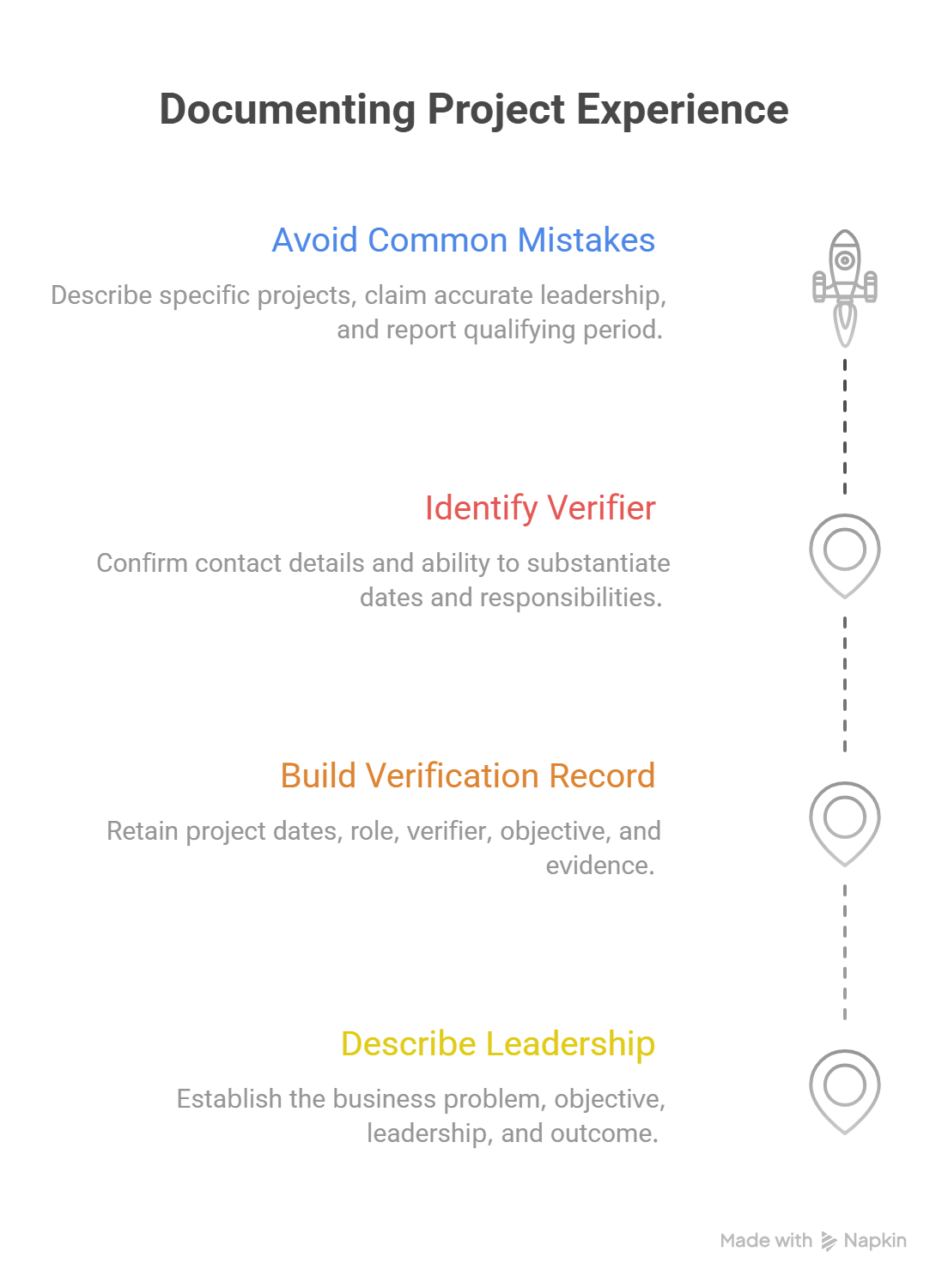
Calculating sufficient months is only part of the application process. Each project must also be described accurately enough for PMI to understand the temporary initiative, the candidate's responsibilities, and the outcome delivered.
A candidate with 50 legitimate months can still encounter difficulties if the application contains vague descriptions, unsupported dates, or routine duties presented as project leadership.
A disciplined documentation process reduces those risks and strengthens the evidence available for verification.
Reviewing PMP application rejection and audit experiences, project management resume guidance, and project governance practices can help candidates identify documentation gaps before submission.
Write project descriptions around leadership and outcomes
A strong experience entry should establish:
The business problem or opportunity that prompted the project.
The temporary initiative's specific objective and deliverable.
The period during which the candidate led or directed the work.
The leadership responsibilities personally performed.
The stakeholders, resources, risks, or changes managed.
The result, acceptance outcome, or transition achieved.
Consider the description: "Worked on a company software rollout and attended team meetings."
It gives an assessor almost no evidence of project leadership.
Where factually accurate, a more useful description would read:
"I coordinated the implementation of a customer management platform across three departments. I developed the rollout schedule, facilitated stakeholder requirements, tracked deployment risks, managed approval milestones, and coordinated user acceptance and operational handover."
The second description identifies a temporary initiative, management responsibilities, and the nature of the deliverable.
Candidates drawing on business analyst experience and technical implementation experience should use the same evidence-based approach.
Build an experience verification record
For each project, retain its name, start and end dates, organization, role, supervisor or verifier, project objective, and documentary evidence that supports the claimed responsibilities.
Useful supporting materials may include project charters, assignment correspondence, approved schedules, stakeholder communications, deliverable acceptance records, and records of leadership responsibility.
Keep confidential client material protected. Where necessary, use permission-based summaries or redacted evidence, and confirm with the relevant organization what information may be disclosed.
A project charter template, RACI responsibility mapping, and a risk register can help reconstruct responsibilities when historical records are fragmented.
Identify the person who can verify each project
An application verifier should have a legitimate basis for confirming the candidate's project role and participation period.
This may be a former supervisor, project sponsor, client representative, or another appropriate professional familiar with the work, depending on PMI's verification instructions.
Confirm that the person's contact details are current and that they can substantiate the project dates and leadership responsibilities described.
Do this before submitting the application. Delays caused by unavailable verifiers or inconsistent records can be particularly frustrating when a candidate has already begun preparing through PMP exam practice resources.
Avoid three common experience-description mistakes
The first is describing normal job duties rather than specific projects. "Managed department operations for four years" does not identify which temporary initiatives were led.
The second is exaggerating responsibilities. Supporting a project is a meaningful contribution, but a candidate should claim leadership only where that leadership actually occurred.
The third is reporting the entire project duration when the candidate led only part of the initiative.
For example, a project may have run from January to December, while the candidate joined its leadership team in May. Their claim should reflect the qualifying period, rather than the full organizational project timeline.
These errors frequently arise when candidates attempt to convert a project management career-change resume into a certification application without a separate experience review.
Candidates concerned about potential verification difficulties should consult PMP audit and documentation guidance before submitting.
5. What to Do If Your PMP Experience Calculator Shows You Are Not Yet Eligible
An eligibility shortfall should lead to a specific development plan, based on the reason the requirements have not been met.
A candidate missing four months of experience needs a different response from someone whose 40-month total falls outside the ten-year window or whose educational qualification does not meet the expected framework level.
The first step is to diagnose the exact deficiency.
Scenario 1: Your experience is sufficient but your education pathway was classified incorrectly
A candidate with 42 unique qualifying months might initially assume they require 60 months because they selected the secondary-school pathway.
If they hold an eligible bachelor's degree, the applicable experience requirement is 36 months.
The candidate may therefore already meet the experience threshold, subject to training and other application requirements.
However, a certificate described as "advanced" or "graduate-level" does not automatically qualify as bachelor-equivalent. Verify official qualification recognition and, where applicable, the required framework mapping.
This is particularly relevant for IT professionals transitioning into project management and experienced project coordinators planning certification.
Scenario 2: You have the required experience but are missing training hours
Complete qualifying project management instruction and retain evidence of the hours completed.
An active CAPM credential can satisfy this component, making it worth checking existing certification status before buying another course.
Candidates researching PMP training and study resources should distinguish legitimate training hours from practice-question subscriptions, books, and independent reading.
A large question bank may be useful for examination preparation, but practice exams and reading alone do not meet PMI's formal training requirement.
The approach should also account for PMI's December 2026 provider restrictions on live instructor-led courses.
Scenario 3: You need another six months of qualifying experience
Identify an actual project leadership assignment that can help close the gap.
Appropriate opportunities may include coordinating a departmental system launch, leading a process transformation, managing a client implementation, directing a product rollout, or taking accountability for an internal improvement project.
The assignment must involve genuine project leadership in a professional setting.
Document its objectives, dates, decisions, stakeholders, risks, and outcomes from the beginning.
A professional following a career roadmap from business analyst to project manager or operations manager to project manager transition may be able to seek greater delivery responsibility without immediately changing employers.
Scenario 4: Your project dates overlap more than expected
Examine the union of qualifying calendar months.
If two projects ran simultaneously for eighteen months, that period contributes eighteen unique months, regardless of how many initiatives were managed.
Look for additional eligible experience from earlier or later projects within the ten-year window, and verify whether all documented periods involved actual project leadership.
Applicants using program management career histories or freelance project portfolios should be particularly careful with concurrent assignments.
Scenario 5: You have extensive experience, but most of it is operational
Look for temporary initiatives within your employment history and document them separately from routine duties.
A department manager may have led a branch opening, technology migration, organizational restructuring, compliance implementation, or service launch in addition to running ongoing operations.
Each initiative requires its own project dates and leadership evidence.
Candidates exploring operations-to-project-management transitions or career progression into project governance can use this review to identify responsibilities worth developing further.
Scenario 6: CAPM is a better immediate certification pathway
Candidates who have not accumulated enough professional project management experience may consider CAPM while continuing to build leadership experience.
CAPM follows a different eligibility framework, making it suitable for some earlier-career professionals.
An active CAPM credential also fulfills PMP's training requirement under PMI's current rules, although the required PMP experience must still be earned separately.
Candidates can explore CAPM preparation resources, common CAPM exam mistakes, and PMP exam preparation techniques to plan a staged certification pathway.
A sound eligibility decision should identify the missing requirement, calculate the remaining gap accurately, and prioritize the next action that moves the candidate toward an application supported by real experience and verifiable records.
6. FAQs: PMP Experience Calculator, Qualifying Months, and Eligibility Requirements
-
PMI's July 2026 pathways require 60 months with eligible secondary education, 48 months with qualifying associate-level education, 36 months with an eligible bachelor's degree or higher, or 24 months with a qualifying PMI GAC-accredited degree. Experience must be non-overlapping and within the preceding ten years.
The relevant pathway should be established before using an experience calculator. Candidates reviewing PMP eligibility and audit experiences should check current PMI requirements rather than older study guides.
-
Yes, both projects can be listed individually when they represent qualifying professional leadership. However, overlapping calendar months count only once toward the required total.
If two eligible projects each run from January through June, the combined experience is six unique months.
This rule is especially important for candidates working in program management, freelance Agile delivery, or multiple concurrent client implementations.
-
A formal project manager title is unnecessary when the candidate can demonstrate genuine professional experience leading and directing projects.
Relevant titles may include business analyst, implementation manager, team lead, operations lead, or project coordinator. The responsibilities and evidence are what matter.
Candidates should examine project management resumes without formal PM titles and business analyst career transitions for examples of how transferable responsibilities can be described accurately.
-
Part-time professional project leadership may be relevant when the work genuinely meets PMI's experience criteria.
The calculation is based on qualifying months, while overlapping project periods cannot be counted repeatedly.
A part-time role still needs identifiable project leadership responsibilities and credible evidence supporting the period claimed. Occasional administrative assistance should not be presented as sustained project leadership.
Candidates with remote project management assignments should record the actual periods and responsibilities involved.
-
Yes, qualifying experience can be gained through professional freelance, contract, or nonprofit projects, including some unpaid professional assignments.
The project must be a genuine temporary initiative with appropriate leadership responsibilities.
Personal events, academic projects undertaken for degree programs, and ordinary household projects are excluded.
Candidates pursuing freelance Agile project management or a nonprofit project management career should keep evidence of client or organizational authority and delivered outcomes.
-
An active CAPM certification satisfies PMI's PMP training requirement. It does not replace the professional project management experience required under the applicable educational pathway.
For example, an eligible bachelor's degree holder with an active CAPM credential still needs 36 qualifying experience months.
Candidates comparing CAPM exam preparation resources with PMP preparation requirements should treat certification training and work experience as separate eligibility components.
