
The PMP exam changed in July 2026, and candidates relying on older Reddit success stories face a serious preparation problem. Recent pass reports describe unfamiliar case studies, demanding questions, unpredictable Study Hall scores, and four hours of decision-making under pressure. Some candidates pass despite modest mock results, while others struggle with concepts they thought they understood. This guide examines verified Reddit experiences, the resources candidates repeatedly use, the preparation mistakes worth avoiding, and a practical six-week strategy for approaching the updated examination.

1. What Changed in the 2026 PMP Exam, and Why Are Older Study Strategies Becoming Unreliable?
The updated PMP examination launched on July 9, 2026, introducing revised domain weightings, additional assessment formats, and greater emphasis on organizational outcomes.
Candidates preparing with materials developed for the previous examination should review the updated requirements before deciding how much additional preparation they need.
The revised examination contains 180 questions, including 170 scored questions and 10 unscored pretest questions. Candidates have 240 minutes to complete the examination and receive two scheduled 10-minute breaks.
The People domain now represents 33% of the examination, Process accounts for 41%, and Business Environment accounts for 26%.
Approximately 40% of questions address predictive project management, while the remaining 60% are divided between adaptive/agile and hybrid approaches.
These changes affect how candidates should distribute their preparation time.
Professionals evaluating PMP certification in 2026 should understand that the examination increasingly emphasizes the relationship between technical delivery, leadership, and organizational strategy.
Why the Business Environment domain deserves considerably more attention
The Business Environment domain previously represented 8% of the examination. Its revised weighting of 26% makes organizational considerations a substantial component of preparation.
Candidates should understand benefits realization, organizational strategy, compliance, changing business priorities, and the relationship between project decisions and organizational outcomes.
Consider a project approaching delivery when a major stakeholder requests additional functionality.
The proposed change could improve customer satisfaction but introduce additional costs and delay the release.
Selecting the appropriate action requires understanding change control, stakeholder engagement, the business case, and the project's delivery approach.
These questions require competencies that overlap with professional business analysis and project governance leadership.
Candidates who already possess substantial delivery experience should identify whether they have comparable knowledge of business-value decisions.
AI, sustainability, and project-based scenarios
The updated examination places additional emphasis on artificial intelligence, sustainability, and stakeholder engagement within practical project situations.
For AI-related questions, study the decisions project managers make when adopting new technologies.
These may involve organizational readiness, implementation risks, data protection, stakeholder expectations, and appropriate oversight.
APMIC's discussion of how project managers use AI provides related professional context.
Candidates can also explore project management responsibilities affected by automation to develop a broader understanding of technological change.
For sustainability, practice evaluating how environmental and social considerations influence project planning, procurement, risk, and long-term benefits.
Focus on understanding how these topics affect actual project decisions.
What recent candidates report about the updated examination
A candidate who reported passing on September 9, 2026, described completing an examination divided into three sections containing 40, 70, and 70 questions.
Their first section included two case studies, with six questions in one and five in the other.
They also encountered several graph-based questions and approximately 40–50 questions requiring careful consideration between plausible answers.
Their greatest difficulty involved sustained concentration and managing examination time.
Another candidate who passed in August reported that their examination felt more direct than some of the particularly difficult PMI Study Hall questions.
These experiences demonstrate the importance of practicing both question interpretation and examination endurance.
Candidates developing practical project management experience should connect examination concepts with real management situations.
Those familiar with traditional and agile project management should practice recognizing when different approaches require different decisions.
Individual Reddit reports offer useful preparation insights. The officially published examination outline remains the reference for examination requirements.
| Study Priority | What to Master | Practice Activity | Readiness Evidence |
|---|---|---|---|
| 1. Exam outline | 2026 domains and tasks | Map resources against the official outline | Every task has appropriate coverage |
| 2. People domain | Leadership and stakeholder management | Practice interpersonal scenarios | Justify appropriate interventions |
| 3. Process domain | Project delivery and controls | Complete mixed delivery questions | Apply processes consistently |
| 4. Business Environment | Strategy, compliance and value | Study business decision scenarios | Explain organizational consequences |
| 5. Predictive delivery | Planning, baselines and change control | Analyze sequential delivery cases | Recognize appropriate formal controls |
| 6. Agile delivery | Adaptive planning and team responsibilities | Practice iterative delivery scenarios | Apply framework responsibilities |
| 7. Hybrid delivery | Combining delivery approaches | Analyze mixed-method projects | Choose context-appropriate responses |
| 8. Stakeholders | Engagement and competing interests | Resolve stakeholder scenarios | Identify effective next actions |
| 9. Conflict resolution | Collaboration and escalation | Practice team conflict questions | Explain proportional responses |
| 10. Risk management | Risk identification and responses | Analyze risk registers | Select relevant risk responses |
| 11. Issue management | Current problems and corrective action | Compare risks and active issues | Identify immediate interventions |
| 12. Change control | Impact analysis and approval | Practice scope change scenarios | Follow applicable governance |
| 13. Scheduling | Dependencies and recovery | Complete schedule analysis exercises | Explain delivery trade-offs |
| 14. Cost performance | Forecasting and financial indicators | Interpret earned value problems | Explain performance results |
| 15. Resource management | Capacity and competing requirements | Practice resource allocation scenarios | Justify allocation decisions |
| 16. Procurement | Contracts and supplier relationships | Analyze supplier disputes | Identify contractual implications |
| 17. Quality | Prevention, assurance and control | Review defect-related situations | Choose appropriate interventions |
| 18. Benefits realization | Deliverables versus business outcomes | Analyze business value scenarios | Connect decisions to benefits |
| 19. AI | Responsible project-level AI adoption | Practice technology implementation cases | Identify relevant oversight needs |
| 20. Sustainability | Long-term project considerations | Analyze sustainability trade-offs | Recognize relevant business impacts |
| 21. Compliance | Regulatory and organizational obligations | Review compliance scenarios | Identify governance implications |
| 22. Data interpretation | Charts and project indicators | Complete graph-based questions | Interpret data accurately |
| 23. Multiple responses | Evaluating multiple correct choices | Complete multi-select exercises | Evaluate every selected option |
| 24. Case studies | Analyzing connected project information | Practice multi-question case sets | Maintain context efficiently |
| 25. Question wording | FIRST, NEXT, BEST and PREVENT | Practice instruction identification | Address the actual question |
| 26. Answer elimination | Comparing plausible alternatives | Explain rejected answers | Justify the selected decision |
| 27. Exam timing | Pacing and concentration | Complete full-length timed mocks | Finish without rushing |
| 28. Error analysis | Recurring reasoning weaknesses | Maintain a structured mistake log | Improve on unfamiliar questions |
2. Reddit PMP Passer Strategies: Which Study Resources Deliver Practical Value?
Reddit candidates regularly discuss Andrew Ramdayal, PMI Study Hall, David McLachlan, Mohammed Rahman, and supplementary preparation notes.
Recent success stories reveal an important distinction between owning preparation resources and using them effectively.
One September 2026 candidate passed with Above Target performance across all three domains despite achieving 60% on their first full-length Study Hall mock and 64% on a subsequent attempt.
Their preparation included structured courses, scenario practice, Study Hall, and targeted revision.
Another successful September candidate reported practicing with Study Hall scores around 60–70%. They found that learning to interpret difficult scenarios and eliminate unsuitable options was particularly useful.
These accounts demonstrate different preparation experiences rather than guaranteed outcomes.
PMI Study Hall: Treat every incorrect answer as diagnostic information
PMI Study Hall appears repeatedly in recent pass reports.
Its primary value is the opportunity to practice scenario interpretation, identify knowledge gaps, and experience extended examination sessions.
However, a single mock score provides limited information about readiness.
After completing practice questions, classify your incorrect answers into four categories.
Knowledge gaps: You misunderstood or had insufficient knowledge of the underlying project management principle.
Interpretation errors: You understood the relevant concepts but overlooked an important detail in the question.
Decision errors: You identified several reasonable options but struggled to select the most appropriate action.
Execution errors: You answered incorrectly because of excessive time pressure, fatigue, or rushed reading.
This classification allows you to develop targeted revision sessions.
For example, repeated mistakes involving project finances may indicate a need to revisit earned value management or cost management principles.
Difficulties involving agile responsibilities may require additional study of Scrum product ownership or advanced Scrum practices.
Maintain an error log recording the original misunderstanding, the relevant management principle, and an example demonstrating the correct application.
Use fresh questions to determine whether your understanding has improved.
Andrew Ramdayal: Establish a foundation for scenario-based reasoning
Andrew Ramdayal's instructional materials appear in multiple successful 2026 candidate reports.
Candidates frequently mention his 35-hour preparation course, examination principles, and challenging question walkthroughs.
The practical objective is to develop a consistent decision-making process.
When approaching a question, first identify the project environment and the problem requiring action.
Determine whether the question concerns a potential risk, an existing issue, an approved change, an interpersonal conflict, or a strategic decision.
Then examine the responsibilities of the people involved.
A project manager operating in a predictive environment may need to follow formal change-control procedures. A similar situation in an agile environment may involve established product ownership responsibilities.
Candidates studying agile project management transitions should practice recognizing these differences.
Additional preparation involving SAFe Agilist principles can provide broader context for scaled delivery environments.
Apply examination principles to the circumstances described in each question rather than assuming that one response fits every situation.
David McLachlan: Practice explaining your answer before hearing it
David McLachlan's question walkthroughs are another frequently mentioned preparation resource.
Use these videos as opportunities for active reasoning.
Pause before each explanation and independently identify your preferred answer.
Write down the information that influenced your decision and explain why you rejected the alternatives.
Compare your reasoning with the explanation.
If you selected an incorrect answer, determine which information you overlooked.
This technique can be particularly valuable for professionals whose existing experience encourages them to interpret questions through a narrow technical perspective.
Someone following a business analyst-to-project manager career path may focus heavily on requirements when a question primarily concerns project governance.
Someone transitioning from software engineering into project management may instinctively prioritize technical solutions over stakeholder or organizational considerations.
Practicing explicit reasoning helps candidates recognize these tendencies.
Mohammed Rahman and supplementary revision resources
A successful September candidate specifically credited Mohammed Rahman's examination principles and question-solving videos with improving their ability to evaluate situations containing multiple plausible answers.
Other Reddit contributors mention supplementary preparation notes, condensed revision materials, and alternative question banks.
These resources can provide useful explanations when your primary course leaves particular concepts unclear.
However, purchasing several resources covering essentially the same material creates additional study demands.
Start with one primary course and a suitable practice-question platform.
Introduce supplementary materials when your error analysis identifies a specific need.
For example, candidates struggling with requirements-related scenarios may explore requirements engineering.
Candidates experiencing difficulties with financial forecasting can revisit earned value management techniques.
Make each additional resource serve an identifiable purpose.
Study Hall Essentials versus Plus
The decision between Study Hall Essentials and Plus should reflect your preparation needs, available time, and the practice materials currently included with each subscription.
Candidates who require extensive full-length simulation may benefit from additional mock-examination opportunities.
Others may obtain sufficient diagnostic information from a smaller number of full mocks combined with detailed question review.
Examine the current subscription contents directly before purchasing.
Prioritize the quality of your review process over the total number of questions completed.
If you have already invested in professional training, carefully managing your preparation resources also improves the overall financial return of PMP certification.
3. PMP Exam Time Management: How to Finish 180 Questions Without Rushing
A four-hour examination requires more than technical knowledge.
Candidates must maintain concentration, interpret unfamiliar situations, and make decisions while monitoring their remaining time.
In one detailed September 2026 report, a successful candidate described completing their first 40 questions in approximately 55 minutes.
They subsequently struggled with concentration during the final section and completed their last several questions quickly.
Their experience illustrates how early timing decisions can influence the final stages of an examination.
Establish your question-solving pace
The examination allows an average of approximately 80 seconds per question.
However, individual questions can differ substantially in complexity.
A straightforward leadership scenario may require limited reading. A complicated case study or graph-based question may demand additional analysis.
Practice using short timed question sets before attempting full-length simulations.
Begin with 20-question sessions, recording your completion time and accuracy.
Gradually introduce longer sessions that require sustained concentration.
During practice, identify questions that consume excessive time.
Determine whether the problem involves insufficient knowledge, unnecessary rereading, or difficulty selecting between plausible answers.
Use this information to improve your pacing.
Candidates familiar with project management reporting systems and project performance measurement may already possess useful analytical skills.
Practicing those skills under examination time constraints remains important.
Apply a consistent decision-making process
When facing a difficult scenario, identify the actual question before examining the available answers.
Pay attention to instructions such as first, next, best, and prevent.
These terms affect which action is appropriate.
Next, identify the project's delivery approach, the problem being described, and the relevant decision-making authority.
Finally, compare the proposed answers.
Consider a situation where a supplier introduces an unauthorized technical modification shortly before delivery.
The appropriate response depends on contractual obligations, change-control arrangements, project risks, and the immediate consequences.
Knowledge of project governance, project cost control, and requirements management helps candidates interpret these circumstances.
Practice selecting the action that addresses the question's specific requirements.
Prepare for examination fatigue and scheduled breaks
The updated examination includes two scheduled breaks.
The first follows the case-study section, while the second occurs approximately midway through the independent-question portion.
Candidates should follow their examination's actual section boundaries and on-screen instructions.
Once a section has been submitted and the corresponding break begins, candidates cannot return to that section.
During practice examinations, monitor your accuracy across successive question blocks.
A noticeable decline toward the end of a session may indicate concentration difficulties or inefficient pacing.
Practice maintaining consistent decision-making over extended periods.
Candidates who also manage demanding professional responsibilities should develop a realistic revision schedule that accommodates their workload.
APMIC's discussion of project management burnout provides related professional context.
Build enough timed practice into your preparation to understand how you perform when tired.
Select your biggest preparation challenge and click Submit for personalized guidance.
Submit
Complete 20 unfamiliar situational questions. Before reviewing each explanation, identify the project environment, underlying problem, and required action. Explain why the alternative answers are less appropriate.
Review your last 30 incorrect answers. Classify each mistake as a knowledge gap, interpretation problem, decision error, or timing difficulty. Prioritize the largest recurring category.
Complete timed practice blocks and record your remaining time. Identify questions causing unnecessary delays. Gradually progress toward realistic full-length examination simulations.
Select one primary preparation course and a suitable practice-question resource. Introduce supplementary materials only when your performance reveals specific knowledge gaps. Develop a consistent revision schedule.
Review PMI's current 2026 Examination Content Outline. Compare its domains and tasks against your existing study materials. Prioritize uncovered topics, including business value, AI, sustainability, and newer assessment formats.
Review your official performance report and previous practice results. Identify whether your difficulties involved knowledge, scenario interpretation, time management, or examination endurance. Verify your remaining eligibility and develop a focused revision plan.
Your selection reveals preparation guidance locally. Responses are not collected or transmitted.
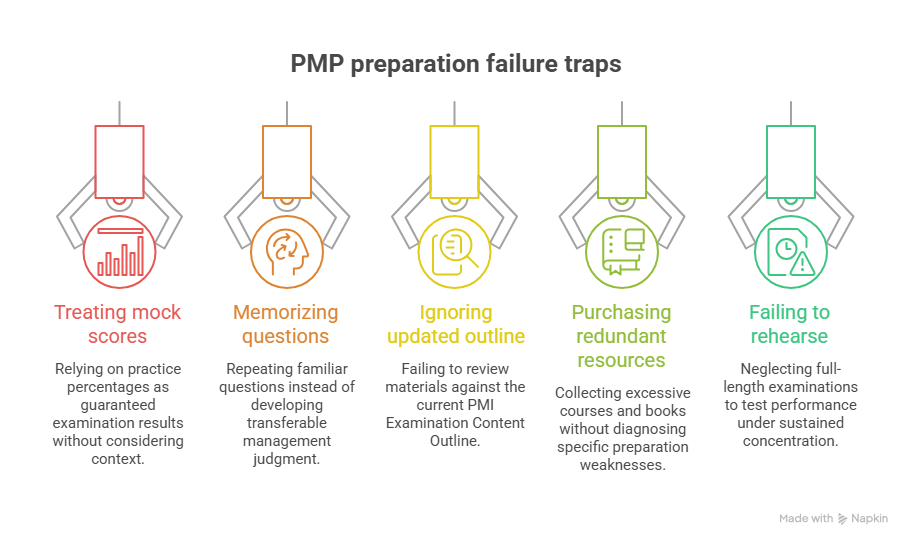
4. The Biggest PMP Failure Traps Revealed by Reddit Preparation Stories
Unsuccessful attempts, difficult mock examinations, and interrupted preparation can reveal weaknesses that additional reading alone may fail to resolve.
Recent Reddit discussions identify several recurring challenges.
These include relying too heavily on practice percentages, spending excessive time on difficult questions, purchasing overlapping resources, and misunderstanding what the updated examination expects.
Recognizing these problems can help candidates establish more effective preparation routines.
Failure trap 1: Treating mock scores as guaranteed examination results
One September candidate passed with Above Target performance across all three domains despite reporting initial Study Hall full-mock scores of 60% and 64%.
Another successful candidate reported achieving approximately 60–70% during preparation while remaining concerned about examination readiness.
These experiences illustrate the limitations of interpreting mock percentages without additional context.
Your readiness assessment should consider several factors.
Have you practiced unfamiliar questions?
Can you explain your incorrect answers?
Does your accuracy remain relatively consistent during extended testing sessions?
Are particular domains producing repeated mistakes?
A candidate achieving 75% while guessing on complex business-value questions may require different revision from someone achieving the same score with balanced performance.
Use practice results to identify your actual weaknesses.
Professionals assessing their PMP certification investment should prioritize measurable preparation improvements over arbitrary score targets.
Failure trap 2: Memorizing questions instead of developing judgment
Repeating familiar questions can produce reassuring scores without necessarily improving transferable understanding.
You may recognize the correct answer while remaining uncertain about the underlying management principle.
Use unfamiliar scenarios to evaluate whether your knowledge transfers to different situations.
For example, transform a predictive change-control question into a comparable agile product-delivery scenario.
Identify which responsibilities change and which principles remain applicable.
Supplementary study of agile project management and business analysis principles can help clarify these differences.
Explain your reasoning before reviewing each answer.
Failure trap 3: Ignoring the updated examination outline
Candidates who began studying before July 2026 may possess substantial foundational knowledge while having limited familiarity with newer examination topics and formats.
Review your existing materials against PMI's current Examination Content Outline.
Identify whether your resources adequately address the expanded Business Environment domain, AI, sustainability, business value, and interactive assessment.
Candidates studying AI-supported project management should consider how technological adoption affects project decisions.
Those with experience in project governance should connect their practical knowledge with the specific examination tasks.
Use targeted supplementary preparation to address uncovered topics.
Failure trap 4: Purchasing resources without diagnosing weaknesses
A large collection of courses, books, notes, and question banks can make preparation unnecessarily complicated.
Some candidates repeatedly review familiar subjects while avoiding the topics responsible for their poorest results.
Your error log should determine your revision priorities.
If stakeholder questions repeatedly cause problems, concentrate on engagement, leadership, and conflict resolution.
If cost forecasting remains difficult, revisit the relevant financial management concepts.
If agile terminology causes confusion, study Scrum responsibilities and agile delivery principles.
Choose resources according to the problems they can help resolve.
Failure trap 5: Failing to rehearse examination conditions
Completing hundreds of short practice questions provides limited insight into how you will perform after several hours of sustained concentration.
Introduce realistic full-length examinations before the final stage of preparation.
Monitor completion time, concentration, accuracy, and the frequency of rushed decisions.
Identify whether your mistakes increase during later sections.
If time pressure remains your largest difficulty, prioritize timed decision-making practice.
Candidates developing professional project management capabilities can apply the same structured problem-solving principles to their professional responsibilities.
5. A Practical Six-Week PMP Study Plan Based on Your Actual Weaknesses
A six-week preparation framework can help working professionals organize their revision.
The appropriate duration will depend on your existing knowledge, professional experience, available study time, and performance on diagnostic assessments.
Use the following schedule as a flexible planning framework.
Week 1: Establish your baseline
Review PMI's updated examination outline.
Identify the tasks associated with People, Process, and Business Environment.
Complete an initial diagnostic assessment using unfamiliar questions.
Categorize your mistakes and identify your weakest areas.
Professionals investigating project management career transitions should consider how their existing professional experience relates to examination competencies.
Week 2: Strengthen foundational concepts
Concentrate on leadership, project delivery, stakeholder management, risk, change control, and the differences between predictive and agile approaches.
Complete topic-specific practice questions after each revision session.
Candidates requiring additional agile preparation can revisit advanced Scrum and agile certification concepts.
Record misunderstandings and revisit them before proceeding.
Week 3: Address updated examination priorities
Dedicate focused preparation time to Business Environment, AI, sustainability, compliance, and benefits realization.
Practice scenarios requiring decisions that balance project delivery with organizational objectives.
Use knowledge of project governance and AI-assisted project delivery to interpret relevant professional situations.
Week 4: Improve scenario interpretation
Complete mixed question sets covering the full examination outline.
Before reviewing explanations, write down why you selected each answer.
Identify questions involving competing plausible responses and analyze the distinctions carefully.
When unfamiliar technical concepts arise, use focused supplementary materials such as earned value management or requirements engineering.
Week 5: Complete realistic examination simulations
Complete at least one full-length timed mock examination.
Analyze your accuracy across sections, identify questions that consumed excessive time, and assess your concentration.
Review incorrect answers and questions answered with low confidence.
Determine whether your remaining weaknesses involve knowledge, reasoning, or examination execution.
Avoid interpreting the overall score without examining these factors.
Week 6: Complete your final readiness assessment
Use the final week to address recurring weaknesses.
Complete another timed simulation if your schedule and concentration permit.
Review your error log and revisit concepts that continue to produce mistakes.
Confirm your examination appointment, identification requirements, testing arrangements, and applicable instructions.
Candidates taking the examination online should complete the required technical checks.
Make your final preparation decisions using evidence from your practice performance and coverage of the current examination outline.
6. FAQs About the PMP Exam in 2026
-
The updated examination introduces revised domain weightings, greater emphasis on business value, and additional scenario-based assessment formats.
Recent candidates describe challenges involving case studies, competing plausible answers, and examination fatigue.
Individual experiences vary considerably, so preparation should cover both the updated content and practical examination execution.
-
PMI does not publish a universal Study Hall percentage that guarantees examination success.
Recent pass reports include candidates achieving different practice scores.
Evaluate your results alongside question familiarity, domain coverage, timing, and your understanding of incorrect answers.
-
Recent successful candidates have reported using Andrew Ramdayal's preparation materials alongside PMI Study Hall.
However, verify that your chosen resources adequately cover the updated examination outline.
Add supplementary materials when your practice results reveal specific knowledge gaps.
Candidates exploring alternative qualifications can compare PMP, CAPM, PRINCE2, and AgilePM.
-
Your preparation time depends on existing knowledge, professional experience, and diagnostic performance.
Establish a study schedule based on identifiable competencies and measurable improvements.
Remember that PMI's formal training requirements are separate from your personal revision schedule.
-
Understand the purpose of relevant formulas and practice interpreting their results.
For example, earned value calculations help identify cost and schedule performance conditions.
Candidates requiring additional preparation can consult earned value management resources.
Avoid allowing formula memorization to displace broader scenario-based preparation.
-
Identify the exact action requested and the project's current circumstances.
Determine the delivery methodology, relevant responsibilities, and underlying problem.
Compare the remaining options according to the timing and requirements described in the scenario.
Practicing agile project management principles and project governance can help clarify context-dependent decisions.
