
Latin America Project Management Industry Report: Original Insights (2026-27)
Latin America’s project management market in 2026-27 is not a story of weak opportunity. It is a story of selective opportunity. Growth across the region remains positive but modest, and that changes the hiring equation. Employers do not reward vague coordination when budgets are tight, funding is staged, and execution risk is high. They reward project managers who can protect timelines, navigate public-private complexity, manage vendors, translate strategy into delivery, and keep multi-stakeholder work moving even when conditions are uneven across countries.
That makes Latin America one of the most interesting project management markets right now. The region is seeing real momentum in energy transition, digital infrastructure, public modernization, logistics, manufacturing repositioning, and investor-backed transformation. But the winners will not be generic PMs with soft claims. They will be specialists with strong documentation habits, clearer business judgment, and proof they can deliver in environments where execution friction is normal, not exceptional.
1. Latin America’s PM market is expanding through targeted investment, not broad-based easy hiring
The first reality professionals need to understand is that Latin America is not moving into 2026-27 with a boom-everywhere environment. The World Bank’s January 2026 regional outlook projects Latin America and the Caribbean growth at 2.3% in 2026 and 2.6% in 2027, while the IDB recently projected 2.1% growth for 2026. Those numbers are not recession language, but they are also not forgiving. In a low-to-moderate growth environment, employers become more demanding about who they hire to lead projects. They want fewer avoidable delays, tighter reporting, better procurement discipline, and PMs who can defend outcomes when capital, public budgets, or investor patience are under pressure.
That is why Latin America is becoming a stronger market for professionals who are positioned around delivery strength instead of title inflation. If someone is building a broader project management career roadmap, mapping their entry-level to executive progression, targeting a project management consultant path, or aiming eventually for project portfolio leadership, the region’s opportunity is real. But it is increasingly tied to sector fit, stakeholder fluency, and the ability to reduce uncertainty for employers and investors. PMI’s 2025 talent-gap report also reinforces the broader global point: demand for project professionals is still outpacing supply over the next decade, which means good PMs remain strategically valuable even when regional growth is uneven.
2. The strongest Latin America PM opportunities are clustering around energy, digital infrastructure, manufacturing, and public transformation
The region’s most interesting PM demand is forming where capital deployment and operational complexity intersect. Clean energy investment in Latin America and the Caribbean rose nearly 25% since 2015 and reached about USD 70 billion in 2025, with Chile, Colombia, and Costa Rica recording major gains while Brazil continued to build momentum through solar PV, bioenergy, and enabling policy. That matters because energy transition projects are never just technical. They are stakeholder-heavy, procurement-heavy, schedule-sensitive, and often exposed to land, permitting, finance, and regulatory friction. PMs who can combine construction project management fundamentals, renewable energy project trends, budget tracking discipline, and contract management terminology are better aligned with where execution pressure is actually rising.
Digital infrastructure is another major lane. IDB-backed analysis notes that remote-area digital infrastructure deployments can cost up to twice as much while generating revenue up to ten times lower than dense urban areas, and GSMA says 28% of Latin Americans live in areas with mobile broadband coverage but still do not use the internet. That combination creates a very specific project environment: PMs must deal with cost asymmetry, adoption barriers, partner coordination, and implementation logic that goes well beyond “install the technology.” This is why the region rewards professionals who study IT project management, strengthen their project communication techniques, sharpen stakeholder management skills, and understand the future of project management software, AI, and cloud integration.
Manufacturing, logistics, and supply-chain repositioning also deserve attention. The OECD’s 2025 regional outlook highlights FDI’s role in production transformation, while ECLAC’s 2025 reporting shows Latin America and the Caribbean attracted FDI equivalent to 2.8% of GDP and 12.6% of global FDI in 2024; Reuters’ summary of the ECLAC report adds that total FDI reached about $188.96 billion, with Brazil and Mexico receiving 38% and 24% respectively. That does not automatically mean every country or sector will be easy. It means cross-border capital is still looking for scalable opportunities, and those opportunities need delivery leaders who can translate investor ambition into governed execution. PMs following an international project management path, a freelance PM career path, or a future PM consultancy model should pay close attention to this.
3. The PM skills Latin America will reward most are governance, execution resilience, and multi-stakeholder control
A lot of professionals still assume the region mainly needs energetic coordinators who can keep meetings moving. That view is too shallow for 2026-27. Latin America increasingly needs PMs who can operate in imperfect conditions without letting the project drift. The macro backdrop is one reason. The World Bank sees growth improving slightly into 2027, but the IDB is still warning about fiscal pressure, high debt-service burdens, and the need for stronger institutions and productivity. In that type of environment, organizations do not pay more for activity. They pay more for control.
That makes governance a front-line skill. A PM who can define decision gates, protect change control, surface risk early, and maintain documentation quality is more valuable than one who merely facilitates status meetings. This is especially true in public modernization, infrastructure, regulated environments, and FDI-backed transformation work. Professionals who deepen their understanding through the government PM roadmap, strengthen issue tracking discipline, improve reporting and analytics quality, and refine document management systems are building exactly the kind of signal hiring panels can trust.
Execution resilience is the second major differentiator. Latin America has plenty of environments where dependencies shift, vendor performance varies, financing is conditional, and rollout realities change between one geography and the next. That is why hybrid delivery skill is becoming more valuable than methodology loyalty. Teams need PMs who can blend structure with adaptability. They need people comfortable with hybrid project management, agile project management pathways, the Certified Scrum Master route, and even the move toward agile coaching when team maturity becomes a delivery bottleneck. The point is not that every project should become agile. The point is that rigid PMs lose leverage in uneven operating conditions.
In Latin America, career growth often comes from solving one credibility gap first, then building proof around it.
4. Certifications and specialization will matter more in Latin America because employers want faster trust
One of the most practical realities in this market is that screening friction can be high. Employers, investors, consultancies, public entities, and multinational firms all want to reduce hiring risk quickly. That is why certifications still matter, even though they are not enough by themselves. A recognized credential gives the employer one less reason to hesitate. In a region where projects often run across partners, jurisdictions, vendors, and funding constraints, speed of trust matters more than many candidates realize. PMI’s talent-gap work supports the broader conclusion that project expertise remains under pressure globally, and that makes credentials more useful as a signal when employers must choose between several capable applicants.
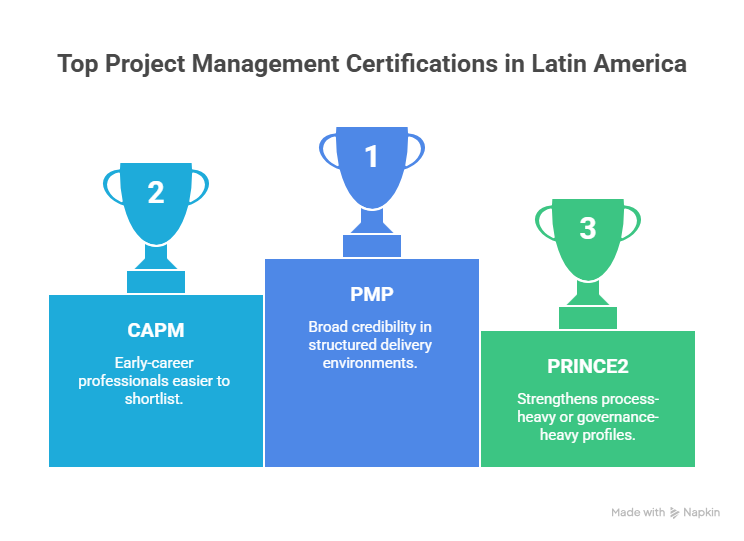
The smarter move, though, is pairing certification with specialization. A PMP path helps if you want broad credibility in structured delivery environments. A CAPM track helps earlier-career professionals become easier to shortlist. A PRINCE2 route can strengthen process-heavy or governance-heavy profiles. A CSM certification path helps in agile-heavy delivery settings. But the highest-value signal comes when the credential clearly supports your chosen lane, whether that lane is IT project management, government project management, construction project management, or international project work.
5. The best PM career strategy in Latin America is to become harder to compare
This is where many professionals underperform. They chase roles instead of building positioning. In Latin America, that is costly because the market can look broad from a distance while being highly selective in practice. The best career strategy is to become difficult to substitute. That can happen in several ways: by owning a strong vertical like energy or digital transformation, by becoming unusually good at governance and executive reporting, by building cross-border coordination strength, or by combining operational delivery with commercial awareness. When the market is not booming everywhere, uniqueness becomes salary leverage.
That is also why future-proofing matters now. The IDB’s recent outlook explicitly points to the need for stronger productivity, institutional quality, and technology adoption, while also noting that AI references in job postings hit a record 7% in 2025. That does not mean PMs are being replaced. It means low-value administrative PM work is becoming easier to automate, while judgment-heavy PM work becomes more valuable. Professionals who invest in AI and project management, machine learning for estimation and scheduling, automation tools for project efficiency, and the broader future project manager skill set will likely gain leverage, not lose it. The same is true for people building toward project management director roles, the path from PM to vice president of PM, and eventually chief project officer leadership.
6. FAQs About the Latin America Project Management Industry Report for 2026-27
-
Yes, but the opportunity is concentrated in sectors and employers where delivery quality directly affects investment returns, modernization outcomes, or operating efficiency. The region’s economic growth outlook is positive but modest, which means project roles are valuable while also becoming more selective. PMs with stronger specialization, governance habits, and stakeholder control will usually outperform generic candidates.
-
Energy transition, digital infrastructure, public-sector transformation, manufacturing repositioning, logistics, and cross-border investment-backed initiatives all look important. Clean energy investment reached about USD 70 billion in 2025, and digital inclusion gaps remain large enough to create significant implementation demand. That mix strongly favors PMs who can handle complexity, not just coordination.
-
Yes, because they help reduce screening risk. They do not replace experience, but they can make employers more comfortable shortlisting you, especially when hiring needs to move quickly or multiple candidates seem similar. The best results come when the credential supports your actual target lane, such as PMP, CAPM, PRINCE2, or CSM.
-
They position themselves as general coordinators instead of delivery assets. In a market shaped by moderate growth, capital discipline, investor scrutiny, and operational friction, employers want PMs who can show risk control, procurement awareness, reporting strength, and business judgment. Resumes that only mention meetings, timelines, and teamwork usually underperform.
-
AI will likely reduce low-value administrative work faster than it reduces demand for strong PMs. Employers still need people who can govern tradeoffs, manage partners, keep projects moving through ambiguity, and communicate clearly under pressure. The PMs who learn to use automation and analytics intelligently will become more attractive in the market.
-
Pick a lane, build proof, and tighten your signal. That usually means combining one credible specialization with one respected credential, then strengthening the operating skills that employers actually buy: stakeholder management, reporting, procurement awareness, documentation, and execution discipline. Candidates who become harder to compare usually become easier to hire.
