
Project managers lose valuable hours reconciling inconsistent updates, chasing action owners, rewriting status reports, and identifying risks buried inside meeting notes. AI can accelerate these activities, but poorly structured prompts introduce another problem: convincing reports built on incomplete or invented information. This AI project manager toolkit provides 50 copy-ready prompts for RAID logs, executive reporting, risk analysis, stakeholder engagement, and project governance. Each workflow emphasizes source verification, accountable decisions, and practical outputs that project managers can use to reduce administrative effort while maintaining control over delivery.
1. How to Use AI Prompts for Project Management Without Losing Control of Your Project
The most effective AI project management prompts combine four elements: verified project context, a narrowly defined task, a structured output, and explicit validation requirements.
A prompt asking AI to "analyze my project risks" leaves too much room for interpretation. A stronger instruction specifies the approved scope, current risk register, reporting date, expected analysis, and information the model must flag as unverified.
This distinction matters across AI-assisted project management workflows, predictive project analytics, project governance, and PMO reporting.
Establish a reusable AI prompt control header
Before using any prompt in this toolkit, supply the following instruction alongside the project data. It establishes consistent expectations across risk analysis, reporting, stakeholder communications, and documentation.
Reusable AI control instruction:
"Act as a project management analyst supporting an authorized project manager. Use only the supplied project evidence for factual claims. Distinguish confirmed facts, calculations, assumptions, recommendations, and missing information. Preserve original owners, dates, currencies, statuses, and approved thresholds. Reference source IDs or document sections wherever available. Do not invent approvals, commitments, decisions, project outcomes, or stakeholder intentions. Identify conflicting evidence and ask for clarification when necessary. Present outputs suitable for human review before distribution or implementation."
This instruction strengthens the reliability of AI-generated status reports, earned value analysis, and project governance documentation.
Prepare the five essential inputs
For reliable AI assistance, create a controlled information package containing:
Project identity: Name, purpose, sponsor, scope, methodology, and reporting period.
Approved baselines: Milestone dates, funding ceiling, success criteria, and decision thresholds.
Current records: RAID log, action tracker, financial data, decision log, and validated updates.
Governance context: Approval owners, escalation rules, confidentiality restrictions, and applicable definitions.
Requested output: Intended audience, format, length, detail, and validation requirements.
Use RACI documentation to establish ownership and project management templates to standardize source records. Where reports include financial metrics, supply the baseline and calculation rules described in earned value management.
Understand where AI assistance ends
AI can summarize evidence, identify patterns, draft alternatives, and expose inconsistencies. Approval of budgets, risk acceptance, scope changes, contractual commitments, and final project reports remains subject to human authority.
For example, AI might identify that a milestone has slipped by eight working days. The PM must verify the underlying schedule and determine whether corrective action requires formal change approval.
The same distinction applies to cybersecurity assessments, vendor dependencies, and program-level decisions.
| AI Workflow | Required Project Evidence | Useful AI Output | Human Validation | APMIC Resource |
|---|---|---|---|---|
| 01. RAID extraction | Approved meeting notes and records | Candidate risks, assumptions, issues, dependencies | Verify category and original source | RAID templates |
| 02. RAID deduplication | Current register and new entries | Duplicate and related-item suggestions | Preserve IDs and ownership history | Register governance |
| 03. Assumption validation | Assumptions, evidence, decision dates | Verification tasks and missing proof | Confirm owner and deadline | Ownership matrix |
| 04. Dependency mapping | Task relationships and handoffs | Predecessor-successor dependency list | Check logic and resource constraints | Schedule analysis |
| 05. Issue escalation | Active issue, impact, escalation thresholds | Decision-ready escalation brief | Validate decision authority | Escalation governance |
| 06. RAID review | Register history and current updates | Stale, incomplete, and conflicting entries | Review corrections with owners | Control standards |
| 07. Weekly reporting | Milestone, RAID, and action updates | Structured weekly status report | Verify dates, status, and exceptions | AI status reporting |
| 08. Executive summary | Validated project status and decision needs | Concise sponsor-level narrative | Confirm implications and approvals | Executive communications |
| 09. Status reconciliation | Workstream updates and source systems | Contradiction and missing-data list | Resolve differences with source owners | Reporting accuracy |
| 10. Schedule variance | Baseline and current forecast dates | Slippage and milestone exposure analysis | Check calendars and schedule logic | Forecasting |
| 11. Cost variance | Budget, actuals, commitments, forecasts | Cost exception narrative | Reconcile to Finance data | EVM calculator |
| 12. Portfolio rollup | Approved project-level status snapshots | Cross-project exception summary | Apply consistent status definitions | PMO leadership |
| 13. Risk discovery | Scope, milestones, constraints, dependencies | Candidate risk statements | Validate relevance and likelihood | Risk identification |
| 14. Risk scoring | Approved scales and risk evidence | Proposed exposure ranking | Check scoring consistency | Risk forecasting |
| 15. Response planning | Risk causes and available controls | Mitigation alternatives | Confirm cost and effectiveness | Risk governance |
| 16. Early warning | Historical trends and risk triggers | Leading indicators and thresholds | Confirm signal reliability | Predictive controls |
| 17. Schedule risk | Dependencies, float, estimates, calendars | Schedule vulnerability scenarios | Verify critical-path assumptions | Performance measures |
| 18. Cost exposure | Rates, quantities, duration, contingency | Best/base/worst illustrative scenarios | Validate formula and ranges | Cost calculations |
| 19. Security risks | Data classifications and technical requirements | Security review questions | Obtain specialist assessment | Cybersecurity planning |
| 20. Pre-mortem | Plan, assumptions, constraints | Failure hypotheses for review | Separate hypotheses from facts | Governance review |
| 21. Stakeholder mapping | Roles, interests, influence evidence | Draft engagement segmentation | Verify subjective classifications | RACI ownership |
| 22. Sponsor briefing | Business outcomes and pending decisions | Decision-focused sponsor brief | Check sponsor authority | Sponsor communication |
| 23. Conflict analysis | Verified concerns and disputed requirements | Options and negotiation questions | Avoid unsupported motives | Stakeholder conflict |
| 24. Decision log | Meeting records and approval evidence | Decisions, rationale, authority, follow-ups | Confirm actual approval | Decision control |
| 25. Change impact | Request, baselines, impacted work | Cost, schedule, scope, and risk assessment | Verify estimate owners | Change templates |
| 26. Meeting actions | Approved minutes or transcript | Owner-action-date list | Confirm implicit commitments | Meeting workflows |
| 27. Acceptance checks | Requirements and approved success criteria | Proposed testable acceptance checklist | Confirm with business owner | Technical acceptance |
| 28. Vendor analysis | Quotations, terms, requirements, evaluation criteria | Supplier comparison and gaps | Check contractual interpretations | Vendor evaluation |
| 29. Release readiness | Test results, defects, rollback evidence | Go/no-go decision briefing | Verify gate ownership and criteria | Release planning |
| 30. Lessons learned | Baseline, incidents, outcomes, team feedback | Root-cause themes and improvement actions | Validate causal claims and owners | PMO improvement |
2. AI Project Manager Prompts 1–20: RAID Logs and Status Reporting
RAID stands for Risks, Assumptions, Issues, and Dependencies. Its purpose is to make uncertainty, current problems, and external requirements visible before they damage delivery.
Effective RAID documentation supports project governance, stakeholder accountability, and evidence-based executive reporting.
RAID Log Prompts: 1–10
Prompt 1. Extract RAID entries from meeting notes
"Review the meeting notes below. Identify candidate risks, assumptions, active issues, and dependencies. For each entry, provide a concise description, source quotation or reference, proposed owner if explicitly named, due date if stated, and required follow-up. Classify ambiguous items separately rather than assigning unsupported categories. Meeting notes: [PASTE NOTES]."
Best use: After steering meetings or delivery reviews where important concerns are buried in discussion. Cross-check entries against your project documentation and ownership matrix.
Prompt 2. Remove duplicate RAID entries
"Compare the existing RAID register with the proposed new entries. Identify exact duplicates, overlapping concerns, and genuinely distinct items. Recommend consolidation only when the underlying event, impact, and required response substantially match. Preserve original IDs, owners, dates, and audit history. Existing register: [DATA]. New entries: [DATA]."
This addresses a common PMO reporting problem: multiple records describing the same exposure while appearing to represent separate threats.
Prompt 3. Classify RAID entries correctly
"Review these project statements and classify each as a risk, assumption, issue, dependency, decision, or action. Explain the classification in one sentence. Identify statements containing multiple concepts and suggest separate entries where necessary. Do not classify a potential event as an active issue without evidence that it has occurred. Statements: [PASTE]."
Use this before preparing a project governance review or reviewing risk registers.
Prompt 4. Convert assumptions into verification tasks
"Examine these project assumptions. For each one, identify the evidence required to validate it, the appropriate verification role, the latest practical confirmation date, and the consequences if it proves false. Separate available evidence from proposed validation activities. Assumptions: [LIST]. Project milestones: [DATES]."
For example, assumed vendor access can become a scheduled test with an assigned technical owner. This strengthens integration planning and schedule forecasting.
Prompt 5. Identify critical delivery dependencies
"Analyze the task list, milestone schedule, and external commitments. Identify prerequisite relationships, handoff owners, lead-time assumptions, and dependencies threatening major milestones. Produce a dependency register with predecessor, successor, evidence source, required date, and escalation trigger. Flag relationships requiring confirmation. Inputs: [SCHEDULE AND TASKS]."
Review the proposed logic before introducing it into a schedule. Unsupported relationships can distort critical-path analysis and resource allocation decisions.
Prompt 6. Detect weak handoffs between teams
"Review the cross-functional workflow below. Identify handoffs where the receiving team lacks a named owner, acceptance criteria, required inputs, or an agreed completion date. Recommend specific coordination questions and a revised handoff checklist. Do not assume undocumented service commitments. Workflow: [PASTE]."
Useful for technical integrations, remote delivery teams, and RACI clarification.
Prompt 7. Prepare a controlled weekly RAID update
"Compare last week's RAID register with this week's verified updates. Identify newly reported items, proposed closures, changed exposure, overdue responses, and unresolved ownership. Produce a change summary referencing the original item IDs. Do not mark entries closed without the required approval or closure evidence. Previous register: [DATA]. Updates: [DATA]."
This improves consistency across recurring project status reports.
Prompt 8. Prioritize RAID items for a steering committee
"Review the active RAID register and approved escalation thresholds. Select up to five items requiring sponsor attention. Rank them by documented exposure, urgency, and decision dependency. For each, provide the evidence, consequences of inaction, available options, recommendation, and required decision date. Register: [DATA]. Thresholds: [RULES]."
This is valuable for executive-level project governance and program oversight.
Prompt 9. Draft an issue escalation briefing
"Prepare a sponsor-ready escalation for issue [ISSUE ID]. Explain what happened, affected deliverables, verified schedule and cost exposure, actions already attempted, recovery options, and the decision required. Use a maximum of 200 words. Distinguish confirmed impacts from estimates and identify the source of each material claim."
A useful escalation supports governance decisions without overwhelming the sponsor with operational history.
Prompt 10. Audit RAID register quality
"Audit the following RAID register for missing owners, outdated review dates, vague descriptions, unsupported closure status, inconsistent classification, and entries lacking actionable responses. Prioritize defects by their effect on decision-making. Return corrections requiring confirmation, rather than silently changing approved records. Register: [PASTE]."
Use this before a PMO review or a formal project governance checkpoint.
Status Reporting Prompts: 11–20
Project status reports should explain what changed, why it matters, and which decisions are required.
Strong AI-assisted reporting workflows combine verified updates with schedule analysis, cost performance, and executive decision rights.
Prompt 11. Generate a weekly project status report
"Create a weekly project status report from these verified milestone, budget, RAID, and action updates. Include reporting period, achievements, next milestones, forecast variances, major risks, blockers, and decisions required. Explain the basis for any proposed RAG status and distinguish draft assessments from approved status. Inputs: [PROJECT DATA]."
Check the resulting report against the approved project baseline before distribution.
Prompt 12. Write a 100-word executive update
"Transform the following detailed project status into a maximum 100-word executive briefing. Prioritize changes to delivery confidence, investment exposure, business outcomes, and sponsor decisions. Preserve material dates and numbers. Omit routine task details unless they affect the decision. Validated status: [PASTE]."
Designed for sponsors managing multiple initiatives through portfolio oversight.
Prompt 13. Consolidate multiple workstream updates
"Combine the validated updates from [NUMBER] workstreams. Report each workstream's milestone status, unresolved dependencies, upcoming commitments, and decisions required. Identify shared blockers and conflicting statements. Preserve original workstream ownership. Inputs: [UPDATES]."
This helps when coordinating global project teams or multi-team Agile delivery.
Prompt 14. Find contradictions in project reports
"Compare these two reporting sources. Identify inconsistent milestone dates, completion percentages, owner assignments, budget values, or risk statuses. List each discrepancy with the source references and clarification required. Do not choose a preferred source without an established authority rule. Reports: [SOURCE A] and [SOURCE B]."
Particularly useful when inaccurate information threatens project reporting credibility.
Prompt 15. Explain milestone variance
"Compare baseline milestone dates with the latest approved forecasts. Calculate variance using the supplied business calendar, explain the documented causes, identify dependent milestones, and distinguish recovered delays from outstanding exposure. Produce a concise narrative for project leadership. Baseline: [DATA]. Forecast: [DATA]. Calendar: [RULES]."
This supports schedule forecasting and escalation through project governance.
Prompt 16. Interpret project cost performance
"Analyze this approved cost baseline, planned value, earned value, actual cost, commitments, and forecast information. Calculate only metrics supported by the available inputs. Explain CPI, SPI, and forecast concerns where applicable. Provide formulas, calculation steps, and missing-data warnings. Data: [FINANCIAL RECORDS]."
Compare calculations with the EVM calculator. Financial forecasts require review by the responsible project governance authority.
Prompt 17. Produce a milestone exception report
"Identify milestones that are overdue, forecast to slip, missing acceptance evidence, or blocked by unresolved dependencies. For each, report the approved baseline, current forecast, responsible owner, reason for exception, recovery action, and escalation deadline. Exclude milestones without verified exceptions. Data: [MILESTONE REGISTER]."
Use this to move beyond activity reporting toward predictive schedule control.
Prompt 18. Prepare a multi-project portfolio summary
"Review the approved status reports for [NUMBER] projects. Identify projects requiring executive intervention, shared resource conflicts, cross-project dependencies, budget exposure, and major upcoming decisions. Apply the supplied portfolio status definitions consistently. Show project-level references behind each conclusion. Reports: [DATA]."
Useful for PMO leaders and professionals progressing toward program management.
Prompt 19. Tailor a status update for different audiences
"Using the same verified project update, create three versions: one for the executive sponsor, one for the delivery team, and one for impacted business users. Maintain identical facts and approved commitments. Change only the level of detail, terminology, and recommended next actions. Source update: [PASTE]."
This improves communication across stakeholder groups without producing conflicting versions of project reality.
Prompt 20. Create a seven-day project lookahead
"Review the upcoming seven working days in the project schedule. Identify planned deliverables, prerequisite approvals, resource constraints, unresolved blockers, and decisions that must occur before work can proceed. Provide a day-by-day coordination checklist with verified owners and required confirmations. Schedule: [DATA]."
Use this for operational project coordination, remote delivery management, and schedule readiness.
3. AI Project Manager Prompts 21–40: Risk Analysis and Stakeholder Management
Risk and stakeholder management require more judgment than routine document preparation. AI can help project managers uncover overlooked scenarios, identify contradictions, and evaluate options. The resulting analysis should remain explicitly provisional until evidence and responsible owners confirm it.
A good risk management workflow connects risk causes to consequences, while strong stakeholder coordination connects concerns to decisions.
Risk Management Prompts: 21–30
Prompt 21. Discover risks from a project plan
"Review this project charter, schedule, resource plan, and dependency list. Identify plausible threats to cost, schedule, scope, quality, and business outcomes. Explain which supplied facts suggest each risk. Separate evidence-backed exposures from hypothetical scenarios requiring specialist review. Inputs: [PROJECT DOCUMENTS]."
Useful before a risk workshop.
Prompt 22. Rewrite vague risk statements
"Rewrite these risk descriptions using cause-event-impact structure: 'Because of [cause], [uncertain event] may occur, resulting in [consequence].' Preserve the original meaning. Identify entries lacking evidence or containing multiple separate risks. Do not add unsupported probability estimates. Risks: [LIST]."
This makes a risk register more actionable and improves governance reporting.
Prompt 23. Prioritize risks using approved scoring rules
"Apply the supplied likelihood and impact scales to the risk evidence below. Propose provisional ratings with explicit reasoning. Identify insufficiently documented risks and any scoring inconsistencies. Do not invent numerical probabilities or treat ordinal scores as expected financial losses. Scales: [RULES]. Risks: [DATA]."
This avoids misleading precision in predictive risk analysis.
Prompt 24. Develop alternative risk responses
"For each material risk, propose avoidance, mitigation, transfer, or acceptance options where appropriate. Explain implementation requirements, likely trade-offs, residual exposure, and required approval authority. Rank options against the supplied project constraints. Risks: [DATA]. Constraints: [DATA]."
Use the results to support project governance decisions, particularly when proposed responses affect the budget baseline.
Prompt 25. Identify early-warning risk indicators
"Review these material project risks and identify observable leading indicators, monitoring frequency, evidence sources, and suggested response triggers. Explain why each indicator could provide useful warning time. Clearly label thresholds that require historical validation. Risks: [REGISTER]. Historical observations: [DATA]."
An example might involve declining supplier response reliability before a contractual delivery failure. This supports predictive project controls.
Prompt 26. Challenge weak risk ownership
"Audit the risk register for ambiguous ownership, actions assigned without authority, multiple competing accountable roles, and responses without deadlines. Suggest the type of role required for each correction. Preserve formally approved assignments until an authorized person confirms changes. Register: [DATA]. RACI: [DATA]."
Useful in cross-functional governance and program management.
Prompt 27. Analyze schedule risk sensitivity
"Using the approved dependency network and duration ranges, identify activities whose delay could affect major milestones. Explain the assumptions, scheduling logic, and potential recovery options. Distinguish calculated schedule impacts from hypothetical sensitivity scenarios. Schedule: [DATA]. Durations: [RANGES]."
Validate dependencies using an appropriate scheduling tool before relying on the output. This complements forecasting methods.
Prompt 28. Model risk-related cost exposure
"Calculate three illustrative cost scenarios for the identified project risk using the supplied cost drivers and assumptions. Show formulas, quantities, rates, and resulting totals. Distinguish direct costs from contingent expenses and explain which assumptions most affect the result. Inputs: [COST DRIVERS]."
Review the resulting analysis alongside earned value and forecast cost metrics.
Prompt 29. Review cybersecurity risks in a project
"Review the project architecture summary, data classifications, vendor interfaces, and planned deployment activities. Identify security questions requiring specialist assessment, including access control, data transfer, recovery, and third-party dependencies. Do not assert compliance or technical security without verified evidence. Inputs: [APPROVED TECHNICAL SUMMARY]."
Use this as preparation for cybersecurity governance reviews and technical integration approvals.
Prompt 30. Conduct a project pre-mortem
"Assume this project has failed to achieve its approved objectives. Generate ten plausible failure hypotheses based on the supplied plan, stakeholder structure, dependencies, and constraints. For each, identify the warning signal that could have appeared earlier and a preventive action for team review. Plan: [DATA]."
A pre-mortem can expose weaknesses before major investments are committed. Integrate findings into risk governance after validating their relevance.
Stakeholder Management Prompts: 31–40
Stakeholder analysis becomes more useful when it captures decision authority, documented concerns, engagement needs, and unresolved expectations.
AI should help organize verified information rather than speculate about individual personalities or hidden motives.
Use RACI ownership guidance, executive stakeholder practices, and project governance controls to validate the resulting engagement plans.
Prompt 31. Build a stakeholder register
"Extract stakeholders from the project charter, organization structure, and meeting records. Document their verified roles, responsibilities, required decisions, known concerns, communication preferences if supplied, and relationships to project deliverables. Identify missing stakeholder information without inventing it. Inputs: [DOCUMENTS]."
Use this to prepare a controlled stakeholder responsibility matrix.
Prompt 32. Prepare a power-interest engagement strategy
"Using the supplied stakeholder roles, authority levels, and documented concerns, suggest provisional power-interest classifications. Explain the evidence supporting each placement and identify uncertain assessments. Recommend engagement frequency, decision checkpoints, and communication objectives for each group. Stakeholder information: [DATA]."
Have the project team review classifications before acting. This supports stakeholder governance.
Prompt 33. Prepare an executive sponsor briefing
"Create a sponsor briefing from the verified project status. Focus on strategic outcomes, financial exposure, unresolved decisions, dependencies requiring intervention, and the consequences of delayed approval. Provide a recommended agenda and three direct questions for the sponsor. Inputs: [STATUS AND DECISION LOG]."
Suitable for executive project leadership and program oversight.
Prompt 34. Analyze conflicting stakeholder requirements
"Compare these stakeholder requirements and identify conflicts concerning scope, deadlines, quality, cost, or responsibility. Explain the underlying trade-off without attributing undocumented motives. Propose clarification questions and decision alternatives for the authorized project owner. Requirements: [DATA]."
Useful when a project involves competing business and technical priorities.
Prompt 35. Draft stakeholder-specific communications
"Write a project update for [STAKEHOLDER ROLE] using the verified facts provided. Explain the change, its practical effect on the recipient, the required action, and the deadline. Use a professional tone appropriate to the relationship. Do not create commitments or approval claims. Source information: [DATA]."
This improves communication within remote project environments and global project teams.
Prompt 36. Prepare for a difficult stakeholder conversation
"Help me prepare for a meeting about [VERIFIED DISAGREEMENT]. Identify the business interests involved, facts both parties need to confirm, constructive questions, possible compromises, and issues requiring higher authorization. Draft an opening statement that avoids blame. Background: [DOCUMENTED FACTS]."
Useful for addressing stakeholder conflict and project stress.
Prompt 37. Extract and validate stakeholder decisions
"Review the approved meeting notes and identify proposed or formally recorded decisions. For each, provide the decision statement, approving authority, date, rationale, affected commitments, and follow-up actions. Flag discussions that ended without explicit authorization. Notes: [DATA]."
A reliable decision log strengthens project governance and prevents informal approval assumptions.
Prompt 38. Plan stakeholder engagement for a major change
"Develop a stakeholder engagement plan for the proposed change [DESCRIPTION]. Identify impacted roles, likely operational questions, required communications, training dependencies, feedback checkpoints, and the approval needed before implementation. Separate known stakeholder concerns from hypothetical concerns to investigate."
This is useful for operations transformation and marketing project management.
Prompt 39. Coordinate communication across time zones
"Using these team locations, working-hour constraints, and delivery dependencies, propose a communication schedule with asynchronous handoffs, decision deadlines, escalation coverage, and necessary meeting overlap. Calculate overlap only from supplied time-zone and working-hour information. Inputs: [TEAM SCHEDULE]."
Useful for international project management and digital nomad project coordination.
Prompt 40. Analyze stakeholder feedback themes
"Review the stakeholder feedback provided. Group comments by recurring issue, affected deliverable, evidence strength, and proposed follow-up. Distinguish repeated independent concerns from duplicate submissions. Identify feedback that could change project scope or acceptance requirements. Feedback: [DATA]."
Use results to strengthen scope governance and project acceptance planning.
Choose your biggest challenge to receive a targeted AI workflow recommendation. This diagnostic does not collect or publish votes.
4. AI Project Manager Prompts 41–50: Change Control, Meetings, Vendors & Delivery Decisions
Projects rarely fail because teams cannot produce another document. More consequential failures arise when approvals remain ambiguous, actions lose ownership, changes bypass authorization, or technical readiness is assumed without evidence.
These ten prompts support decisions involving project governance, procurement and vendor management, Agile delivery, and operational handover.
Change Management and Delivery Prompts
Prompt 41. Analyze a project change request
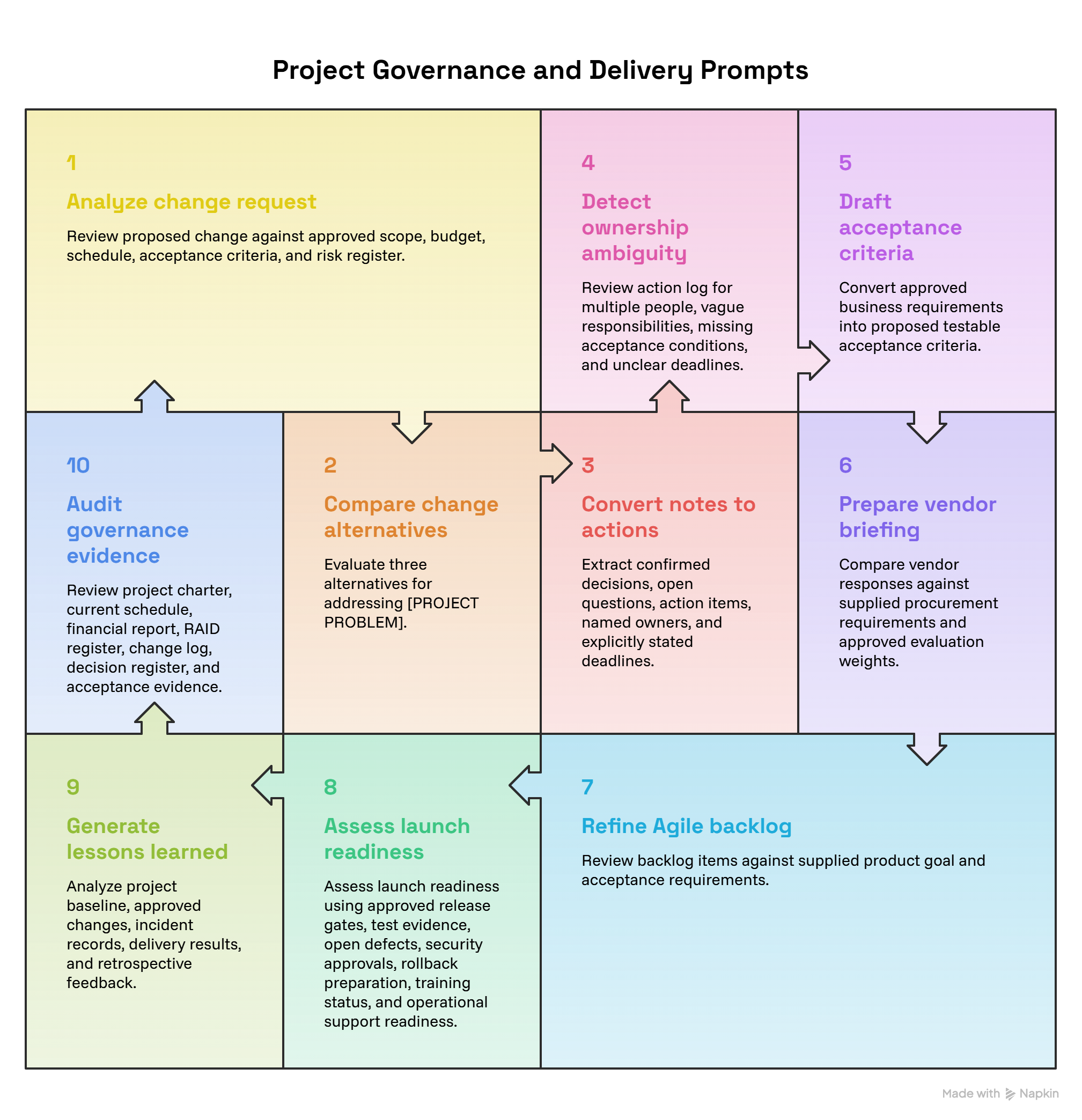
"Review this proposed change against the approved scope, budget, schedule, acceptance criteria, and risk register. Identify affected deliverables, required estimates, potential new dependencies, and decisions requiring formal approval. Produce a change-impact assessment with unresolved information clearly identified. Change: [REQUEST]. Baselines: [DATA]."
Use the output with a formal change-control template.
Prompt 42. Compare alternatives for a change decision
"Evaluate three alternatives for addressing [PROJECT PROBLEM]: [OPTION A], [OPTION B], and [OPTION C]. Compare their documented cost, schedule, quality, resource, risk, and benefits implications. Identify assumptions affecting the recommendation. Provide a decision briefing without presenting any alternative as authorized."
This improves investment reasoning for senior PM consultants and executive sponsors.
Prompt 43. Convert meeting notes into actions
"Analyze these approved meeting notes. Extract confirmed decisions, open questions, action items, named owners, and explicitly stated deadlines. Distinguish proposed actions from accepted commitments. Flag any item without a verified owner or date. Produce an action log and concise meeting summary. Notes: [PASTE]."
This is among the more practical AI meeting workflows.
Prompt 44. Detect ambiguous action ownership
"Review this project action log for entries assigned to multiple people, vague responsibilities, missing acceptance conditions, and unclear deadlines. Recommend clarification questions and a proposed single accountable owner role where appropriate. Do not overwrite existing assignments. Log: [DATA]."
Compare recommendations with the approved RACI matrix.
Prompt 45. Draft measurable acceptance criteria
"Convert these approved business requirements into proposed testable acceptance criteria. For each, identify the condition to verify, evidence required, expected result, tolerance where defined, and responsible approver. Flag subjective requirements and missing thresholds for business-owner clarification. Requirements: [DATA]."
Especially valuable for IT implementation projects and technical integrations.
Prompt 46. Prepare a vendor evaluation briefing
"Compare vendor responses against the supplied procurement requirements and approved evaluation weights. Identify compliance gaps, exclusions, contract dependencies, delivery assumptions, and questions requiring supplier clarification. Calculate weighted scores only where complete inputs exist. Do not infer contractual commitments. Vendors: [PROPOSALS]. Criteria: [SCORING RULES]."
Supports procurement governance and professional supplier evaluation.
Prompt 47. Refine an Agile delivery backlog
"Review these backlog items against the supplied product goal and acceptance requirements. Identify unclear user value, oversized items, duplicate requirements, dependencies, and questions for the Product Owner. Suggest decomposition and possible sequencing while preserving approved priorities and Scrum accountabilities. Backlog: [DATA]."
Use within Agile project management or scaled Agile coordination.
Prompt 48. Prepare a launch go/no-go briefing
"Assess launch readiness using the approved release gates, test evidence, open defects, security approvals, rollback preparation, training status, and operational support readiness. Identify satisfied, failed, and unverified criteria. Explain the consequences of outstanding conditions. Prepare a recommendation for the authorized decision-maker. Evidence: [DATA]."
Critical for technical deployments and cybersecurity-sensitive projects.
Prompt 49. Generate an evidence-based lessons-learned report
"Analyze the project baseline, approved changes, incident records, delivery results, and retrospective feedback. Identify recurring causes, documented consequences, successful interventions, and proposed improvements. Distinguish observed relationships from unverified causal explanations. Recommend actionable process changes with review owners. Inputs: [PROJECT RECORDS]."
Useful for PMO continuous improvement.
Prompt 50. Audit a project governance evidence pack
"Review the project charter, current schedule, financial report, RAID register, change log, decision register, and acceptance evidence. Identify inconsistencies involving scope, dates, owners, approval status, costs, and outstanding obligations. Produce a prioritized findings list with source references, proposed verification actions, and responsible review roles. Documents: [APPROVED RECORDS]."
Use before a steering committee review or formal program assurance checkpoint.
5. How to Implement an AI Project Management Toolkit That Saves Time and Produces Reliable Results
The safest way to introduce AI into project delivery is to begin with a bounded workflow, establish measurable quality criteria, and expand only after the outputs prove useful.
Organizations attempting to automate every status report, risk register, and stakeholder communication simultaneously can magnify inconsistent source data across the entire portfolio.
The following implementation framework brings together AI workflow practices, PMO governance, cybersecurity controls, and project performance measurement.
Step 1. Select three low-risk workflows
Start with a verified meeting summary, a RAID quality check, and a weekly status draft.
These workflows offer relatively clear source records and observable quality measures.
Avoid beginning with automatic budget approvals, contractual interpretation, regulatory compliance judgments, or unreviewed stakeholder communications.
For each pilot, establish a named reviewer and document the allowed data categories. Use project templates to standardize inputs and RACI assignments to clarify responsibility.
Step 2. Establish a source-of-truth hierarchy
Specify which records govern disputed information.
For example:
Approved baseline: Authoritative source for authorized commitments.
Current project system: Source for verified task and milestone updates.
Approved change log: Source for subsequent baseline modifications.
Finance records: Source for actual expenditure and authorized commitments.
Meeting notes: Supporting evidence requiring confirmation for new decisions.
If AI finds a conflict between a meeting summary and an approved decision record, the discrepancy should be escalated for verification.
A consistent source hierarchy strengthens governance reliability and improves project reporting accuracy.
Step 3. Define output quality measures
Track the following during pilot reviews.
Factual accuracy: Percentage of material claims supported by supplied evidence.
Action completeness: Percentage of confirmed action items captured with correct ownership and deadlines.
Critical error rate: Number of incorrect claims affecting budgets, milestones, approvals, risk exposure, or contractual commitments.
Review effort: Minutes required to verify and correct each output.
Time saved: Manual preparation time minus AI preparation and verification time.
Decision usefulness: Whether the output clearly identifies the consequence, alternatives, and required owner.
These metrics allow teams to examine actual productivity rather than relying on perceived speed. They can also support future analytics-driven PMO improvements.
Step 4. Apply security and confidentiality controls
Before uploading project material, verify the organization's AI policy, approved vendors, data-processing terms, and permitted information classifications.
Sensitive project records may include commercial pricing, employee information, unreleased financial results, private stakeholder communications, security vulnerabilities, and contractual documents.
Where full records cannot be used, supply authorized redacted data or fictional scenarios designed to test workflow quality.
Do not assume a tool's privacy settings make it suitable for every classification of project information.
Project managers involved in cybersecurity planning, international development, or enterprise governance may need additional organizational approvals.
Step 5. Run a four-week controlled rollout
Week 1: Approve the permitted use cases, data boundaries, control header, and validation criteria. Create a small representative test dataset.
Week 2: Run the RAID and meeting-action prompts against known records. Measure missed items, unsupported claims, and correction effort.
Week 3: Test status summaries and risk analysis. Require project managers to confirm calculations, assumptions, ownership, and recommended escalations.
Week 4: Review quality results, calculate net time saved, document failure patterns, and decide whether to expand the toolkit.
Retain approved prompt versions and document significant changes to their instructions or expected outputs.
This creates a practical foundation for broader AI automation in project management and PMO capability development.
Step 6. Measure the productivity benefit correctly
Consider an illustrative pilot involving 12 weekly project reports.
If each report previously required 40 minutes, the manual workload totaled 480 minutes.
Suppose AI-assisted preparation reduces drafting to 12 minutes per report, while verification takes another 10 minutes.
The revised workload becomes:
12 × (12 + 10) = 264 minutes.
Net weekly time saved = 480 − 264 = 216 minutes, or 3.6 hours.
The workflow delivers a 45% reduction in preparation and review time under these assumptions.
However, a single material reporting error could outweigh those savings. Track critical error rates alongside productivity and investigate any incorrect financial, contractual, or approval-related claim.
Use cost performance principles when evaluating the investment and predictive analytics practices when assessing whether the improvement is sustainable.
6. AI Project Manager Toolkit FAQs
-
The most valuable prompts address repeatable work with clear source evidence and measurable output requirements.
Strong starting points include RAID extraction, weekly status drafting, meeting-action summaries, milestone exception analysis, and decision-log preparation.
More advanced applications include risk sensitivity assessment, change-impact analysis, and project governance reviews.
Use prompts appropriate to your project's maturity and available data. The AI project management workflow guide and project templates library provide useful starting points.
-
AI can assist with extracting proposed entries, identifying duplicates, detecting missing information, and preparing updates.
Reliable maintenance requires a controlled source of truth, explicit ownership, version history, validation rules, and authorization for material changes.
An AI-generated closure recommendation should not automatically become a confirmed closure.
Combine the toolkit with governance controls and a maintained RACI matrix.
-
Require source references, label assumptions explicitly, and prohibit unsupported approvals or commitments.
Provide the authoritative project records rather than relying on a general description of the initiative.
When using AI to investigate risks, treat newly generated scenarios as hypotheses requiring validation.
For financial reports, independently verify calculations through the earned value calculator. For scheduling decisions, check underlying logic using project forecasting methods.
-
Yes, when an approved integration or authorized export supplies the required records.
The output quality depends on the completeness and accuracy of the underlying data.
A useful status-reporting workflow reconciles current updates with approved baselines, outstanding decisions, and risk information.
Review relevant project software comparisons, API integration guidance, and AI reporting practices.
-
The appropriate tool depends on its supported features, organizational approval, data-handling controls, integration capabilities, and the complexity of the workflow.
General-purpose AI assistants can help with document analysis and drafting. Project management platforms with AI features may provide additional context from connected project records.
Before selection, test the tool using representative tasks and verify access controls, output reliability, and practical review effort.
Use PM integrations guidance and AI project automation workflows to assess the operational fit.
-
AI can automate portions of documentation, information consolidation, report drafting, and routine analysis.
Project leadership continues to require accountability for investment decisions, trade-offs, stakeholder relationships, delivery authority, and organizational consequences.
The nature of coordination work is likely to evolve as repetitive administration becomes easier to automate.
Explore the AI automation skill map for project managers, project coordinator career progression, and PMO leadership pathways.
