
Centennial Yards Project Management Update
Centennial Yards in Atlanta is not just another downtown redevelopment. With Live Nation committing a reported five billion dollars in content, operations, and long term partnership, the project shifts from a speculative mixed use district into a highly programmed entertainment engine. For project managers, this changes everything: risk profile, governance, stakeholder power, and how the PMO should run the portfolio of phases. In this article, we treat Centennial Yards as a live case study that you can map directly to your own mega urban projects.
We will break the deal into governance, financing, risk, PMO structure, and stakeholder strategy, while linking each piece back to repeatable tools, glossaries, and certification paths such as the guides on project initiation terms, top 100 project management terms, and project risk management terminology.

1. Why the Live Nation Deal Changes the Centennial Yards Project Story
Before the Live Nation agreement, Centennial Yards looked like a complex but typical brownfield redevelopment: offices, residential, retail, and some entertainment. Once a global live entertainment company signs on for multi decade activation, the asset turns into a content platform. That shift forces the PMO to anchor every design, phasing, and infrastructure decision to event economics, visitor flows, and show scheduling. It is similar to how a project manager reanchors exam preparation using the CAPM 30 day study plan or PMI ACP expert tips instead of ad hoc reading.
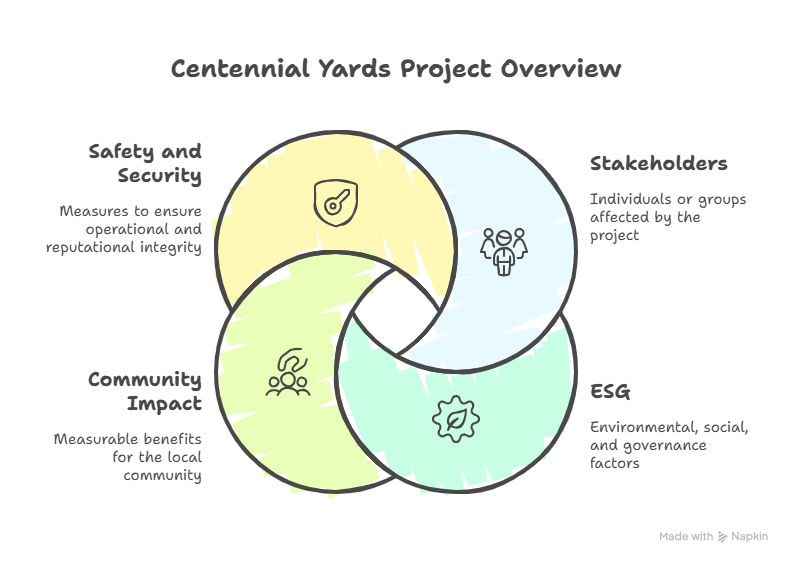
The risk profile also changes. Live Nation’s commitment reduces demand risk for venues but amplifies operational and reputational risk. A cancelled tour, safety incident, or transport disruption can wipe out an entire season’s revenue. The PMO must therefore integrate terminology and practices from cost management, issue tracking, and stakeholder management much earlier than in a standard real estate project.
The macro environment adds another layer. Inflation, rate cycles, and construction sector pressure have already hit large developments globally, as covered in the analyses of global inflation’s impact on project budgets, economic uncertainty increasing agile demand, and UK construction sector downturn. Centennial Yards must be delivered in that context, so the PMO cannot rely on static assumptions. It needs scenario planning baked into its processes.
2. PMO and Governance Structure Behind a Live Nation Anchored Mega Project
A project of this scale and complexity cannot rely on a single project manager. It requires a master development PMO that treats each phase, parcel, and venue as a program within a single portfolio. Governance starts with clearly defined gates and decision rights, similar to the structures described in the Certified Project Director exam guide, the Certified Project Management Practitioner preparation, and the IAPM exam insights.
At Centennial Yards, gate reviews should bring together city representatives, developers, Live Nation, transit agencies, and major lenders. Each gate requires evidence on risk registers, funding status, entitlements, and ESG commitments. Adopting common language from the risk management glossary, risk identification terms, and project issue tracking guide allows this diverse group to debate facts instead of semantics.
The PMO also sets rules for how agile practices blend with formal governance. Entertainment programming, digital experiences, and retail concepts will evolve rapidly. Civil works and transit links will not. The hybrid approach outlined in Scrum versus Agile certification comparisons, Scrum role explanations, and PMI ACP exam questions shows how to keep decision cycles short for innovation while maintaining strict control on critical paths.
3. Financing, Risk Allocation, and Phasing in a Five Billion Dollar Entertainment District
Live Nation’s deal changes the financing stack. Long term content and operating commitments support debt and equity valuations, but they also lock the project into performance thresholds. The finance function, working with the PMO, must quantify how event volumes, ticket pricing, and non ticket spend feed into cash flows. Concepts from the global project management salary report, the project manager salary comparison by certification, and economic pressure driving software investment all underline how sensitive outcomes are to macro shifts.
Risk allocation sits at the center of negotiations. Construction risk, event performance risk, macro risk, and political risk should be distributed based on who can manage each best. Procurement and contract structures draw heavily on concepts cataloged in the project procurement terms guide, the contract management terminology article, and the review of procurement tools. Poorly designed contracts invite claims, change orders, and misaligned incentives with contractors and operators.
Phasing decisions become strategic, not just logistical. The team must decide whether to open anchor venues first to establish footfall or to build a critical mass of residential and office space. This requires scheduling rigor informed by the critical path method glossary, the scheduling terms guide, and resource allocation software comparisons. In practice, the PMO runs alternative phasing scenarios and tests them against transport capacity, cash flows, and Live Nation programming commitments.
4. Stakeholders, ESG, and Community Impact in Atlanta’s Centennial Yards
Atlanta is not just another market on a spreadsheet. It is a city with specific histories of displacement, transport politics, and racial inequity. A Live Nation anchored district in that context brings intense scrutiny. The PMO must therefore treat stakeholder and ESG work with the same discipline as cost control. The frameworks in the critical stakeholder terms guide, the project communication terminology article, and the team building glossary provide a vocabulary for that work.
Community benefits must be measurable, not aspirational. The global analyses of sustainability and ESG project management, project management as a driver of economic growth, and digital transformation in PMOs all show that ESG outcomes can be tracked with the same clarity as budgets. For Centennial Yards, that means dashboards on local hiring, small business participation, housing affordability, carbon emissions, and noise impacts.
Safety and security carry both operational and reputational stakes. Crowd management, cyber security for ticketing and payments, and the resilience of digital systems must align with concepts described in the advanced persistent threats guide and the review of major cybersecurity concerns in PM software. A failure in any of these areas can undo years of trust building with the city and Live Nation’s global audience.
5. Lessons for Project Managers and Certification Candidates
For project professionals, Centennial Yards with a Live Nation deal demonstrates how far modern PMO work extends beyond Gantt charts. It combines cost, risk, ESG, stakeholder strategy, digital platforms, and macro economics. Building a career that can handle work at this level means going beyond generic certifications and linking your learning to advanced content such as the CompTIA Project exam guide, the Certified Project Director exam overview, and the Six Sigma Green Belt exam guide.
Start with vocabulary. The glossaries on project management terms, cost terms, and project quality management terminology give you the baseline to contribute in multi stakeholder rooms. Add agile and Scrum fluency using the Scrum Master certification guide and the Scrum roles article.
Then deepen in ESG, digital, and risk. Content on blockchain in project management, AI adoption in PM, and comprehensive risk management shows how forward leaning PMOs operate. When you combine that knowledge with experience on smaller mixed use or infrastructure projects, you position yourself for roles in PMOs that govern billion dollar entertainment districts like Centennial Yards.
6. FAQs: Applying Centennial Yards Lessons to Your Own Mega Projects
-
A Live Nation anchored project carries a long term operating partner whose business model depends on event throughput, fan experience, and brand safety. The PMO must integrate these needs into zoning, design, transport, and digital systems. It uses governance and terminology similar to those described in the project initiation terms guide, the stakeholder terms article, and the project communication glossary. In practice, more decisions hinge on event economics and audience flows than on pure rent or sale values.
-
The highest leverage starting point is a lean but strong master development PMO that owns phase gating, risk registers, and stakeholder mapping. Use templates inspired by the risk management glossary, the cost management terms guide, and the project procurement terminology article. Build a single portfolio dashboard so executives and public partners see the same cost, schedule, and ESG picture. Once this foundation is stable, layer in digital platforms, AI analytics, and detailed phasing models.
-
You need both language and tools. The critical stakeholder terms guide and the team building glossary give you vocabulary to describe stakeholder power, influence, and engagement styles. The project communication terms article helps you design communication plans that suit mayors, community groups, lenders, and private operators. Practically, you should map stakeholders early, define what success means to each, and align CBAs and design choices with that map instead of treating engagement as a late stage mitigation measure.
-
ESG and community outcomes must sit at the same level as cost and schedule, not as a side function. The PMO should assign clear ESG ownership, define quantifiable KPIs, and link them to each phase gate. The approaches described in sustainability and ESG project management and the economic growth article show how this can be done. For Centennial Yards, this would include transparent reporting on local hiring, affordable housing, carbon footprint, and small business participation, with consequences when commitments are missed.
-
Start with foundational credentials such as CAPM, supported by resources like the CAPM 30 day plan, then move into agile and risk centric certifications using the PMI ACP tips and PMI ACP question bank. From there, advanced programs like the Certified Project Director, CPMP guide, and CompTIA Project exam overview help you build portfolio level skills. Combine these with real experience on urban, mixed use, or infrastructure projects to become the type of leader a Centennial Yards scale PMO needs.
-
A PMO should design contracts around performance frameworks, not static obligations. That means Live Nation commits to event volume, programming diversity, and safety standards, while the developer commits to infrastructure, digital systems, and district operating readiness. Tools from the contract management terminology guide, the procurement terms glossary, and the issue tracking handbook help structure escalation paths, shared KPIs, and financial incentives. The goal is to allow adaptation to market conditions—touring cycles, economic shifts, or technology changes—without reopening the entire deal. Flexibility is built into mechanisms, not renegotiations.
-
The PMO should monitor a mix of economic, ESG, operational, and community-based metrics. Economic indicators include visitor spend, retail uplift, hospitality revenue, and event utilization rates. ESG metrics follow models described in the sustainability and ESG project management guide, covering carbon intensity, water use, and waste reduction. Community metrics include local hiring ratios, small-business participation, affordable housing delivery, and noise or congestion impacts. Operational indicators track transport reliability, safety performance, and digital system uptime. When reported transparently—using dashboards similar to those in modern PMOs described in the digital transformation analysis—these metrics demonstrate whether the district is fulfilling promises to the city, Live Nation, and investors.
