
Australia Awards $68M Contract for Carpentaria Highway Project (Stage 3)
When a government signs a $68 million contract for a remote highway upgrade, it’s not “just another construction project” – it’s a live case study in portfolio prioritisation, risk allocation, and ESG-centric delivery that every serious project manager should dissect. The Carpentaria Highway Stage 3 contract illustrates how governments translate economic pressure, supply chain risk, and regional development goals into structured work packages that align with best practices you see in guides like Top 100 Project Management Terms You Must Know, Comprehensive Project Risk Management Glossary, and Sustainability & ESG in Project Management.
In this article, we’ll break down Stage 3 from a project management lens, map the contract to scheduling, cost, risk, and procurement concepts covered in APMIC’s exams, and extract practical lessons you can apply whether you manage transport, IT, or ESG programmes – and whether you’re targeting CAPM, PMI-ACP, or Certified Project Director (CPD).

1. Why the Carpentaria Highway Stage 3 Contract Matters to Project Managers
On the surface, Stage 3 is a regional road upgrade aimed at improving freight routes, safety, and flood resilience. But structurally, it’s a multi-phase infrastructure programme that pulls together everything you study in Project Initiation Terms, Project Scheduling Terms, and Project Procurement Terms & Definitions.
The $68M price tag reflects bundled scope elements – pavement rehabilitation, widening, flood immunity works, drainage, and safety upgrades – all of which must be sequenced using concepts described in Critical Path Method (CPM) Terms and managed with the cost discipline you see in Top 20 Cost Management Terms for Project Managers. For candidates preparing via the Global Project Management Salary Report, this project is a perfect real-world anchor for understanding how large budgets are justified and governed.
Stage 3 also illustrates portfolio logic. Governments are juggling cyber resilience programmes (like those discussed in Major Cybersecurity Concerns Prompt Project Management Software Overhaul), digital transformation initiatives (Digital Transformation Accelerates Across PMOs), and transport upgrades in parallel. Carpentaria only gets funded when it beats other candidates on strategic alignment, risk exposure, and long-term economic benefit – exactly the kind of decision-making you study in Project Manager Salary Comparison by Certification and Sustainability & ESG in Project Management.
For you as a project professional, treating this contract as a live case study sharpens your ability to connect exam vocabulary from Top 100 PM Terms with how governments actually write contracts, structure milestones, and allocate risk to contractors.
| Dimension | What It Looks Like in Stage 3 | Relevant APMIC Focus Area |
|---|---|---|
| Business Case | Freight efficiency, regional development, safety | Project initiation, benefits realisation |
| Funding Source | Federal–state cost-sharing arrangements | Stakeholder & contract management |
| Contract Type | Fixed-price with variations and risk-sharing mechanisms | Procurement & contract terms |
| Scope | Pavement rehab, widening, drainage, flood immunity | Scope management & WBS design |
| Schedule | Seasonally constrained construction windows | CPM, critical chain, buffers |
| Budget | $68M for Stage 3 (multi-year) | Cost baselines & control accounts |
| Risks | Weather, supply chain, labour, environmental approvals | Risk identification & mitigation |
| Quality | Design standards, pavement performance, safety outcomes | Quality planning & control |
| Stakeholders | Federal government, state agencies, communities, freight operators | Stakeholder analysis & engagement plans |
| Procurement | Tendering, prequalification, contract award | Procurement strategy & sourcing |
| Environmental & ESG | Flood resilience, habitat protection, emissions from works | ESG integration into project plans |
| Safety | Worksite safety & road-user safety outcomes | Risk & quality integration |
| Communications | Updates to local communities & road users | Project communication planning |
| Change Control | Variation orders for scope shifts | Integrated change control |
| Issue Management | Unexpected ground conditions, delays, claims | Issue tracking & resolution |
| Technology | Design tools, scheduling platforms, PMIS | PM software selection & integration |
| Resource Management | Skilled crews, plant, specialist subcontractors | Resource allocation & levelling |
| Governance | Steering committees, reporting, gateway reviews | Governance frameworks |
| Legal & Compliance | Construction law, environmental regulation, land access | Compliance and contract law basics |
| Risk Transfer | Allocation of weather and ground-risk to parties | Risk-based contracting |
| Supply Chain | Quarries, transport, fuel, local suppliers | Cost & procurement risk |
| Digital Records | As-built data, test records, change logs | Project documentation management |
| Benefits Tracking | Travel time savings, crash reductions | Benefits realisation management |
| Lessons Learned | Feeding Stages 1–2 insights into Stage 3 | Continuous improvement |
| Certification Relevance | Direct mapping to CAPM / PMP domains | APMIC exam preparation |
2. Breaking Down Stage 3: Scope, Stakeholders, and Risk
From a scope management perspective, Stage 3 is a textbook example of decomposing a high-level objective (“upgrade highway to improve safety and freight efficiency”) into manageable work packages. The WBS draws heavily on principles you see in Project Scope and Quality Terms, Project Scheduling Terms, and Complete Guide to Six Sigma Terms for Project Managers. Pavement reconstruction, drainage upgrades, culvert replacements, signage, and line marking each become discrete but interdependent chunks.
Stakeholder mapping is equally rich. You have national and state transport agencies, local councils, indigenous communities, heavy-vehicle operators, environmental regulators, and residents – all with different risk appetites and success criteria. This is where concepts from Critical Project Stakeholder Terms Every PM Should Master, Essential Project Communication Terms & Techniques, and Complete Guide to Team-Building Terminology for PMs move from textbook to reality. A single poorly handled road closure or consultation round can trigger political and reputational risk disproportionate to the cost.
On the risk front, Stage 3 is a live lab for the terms you study in Top 25 Risk Identification & Assessment Terms and Comprehensive Project Risk Management Glossary. Flooding risk must be quantified using historical data; geotechnical uncertainty must be mitigated through investigations and contingency; supply chain fragility (for aggregates, asphalt, and fuel) needs response plans amid inflation and volatility. Each of these risks flows into the contract structure – through allowances, escalation clauses, and shared contingency – linking back to Essential Contract Management Terminology for Project Managers and Complete Guide to Project Procurement Terms.
3. Managing Remote and Regional Delivery at Scale
Carpentaria’s location makes this a remote and regional project, not an urban motorway upgrade. That brings in themes you see in Remote Project Management Gains Global Acceptance, Best Project Management Software for Small Businesses, and Top Resource Allocation Software Solutions for PMs. Workforces must be housed, materials transported over long distances, and wet-season access windows carefully planned.
From a scheduling perspective, this is where CPM and resource levelling jump off the exam page. Earthworks, structures, sealing, and line marking must be threaded through tight climatic windows described in Critical Path Method Terms Clearly Defined and shaped by resource constraints. A single delay in mobilising plant can compress subsequent activities into unsuitable weather, directly challenging concepts from Project Scheduling Terms 2025.
Remote delivery also elevates team-building and communication challenges. You may have fly-in–fly-out crews, local subcontractors, and client representatives working from different regions. The terminology in Essential Project Communication Terms & Techniques, Complete Guide to Team-Building Terminology for PMs, and Essential Human Resource Management Terms in PM becomes intensely practical: toolbox talks, safety briefings, pre-start meetings, and digital progress dashboards must all work together to keep everyone aligned.
Finally, remote projects amplify issue and risk management discipline. When the nearest supplier is hundreds of kilometres away, every disruption can become a major issue ticket. This is exactly why APMIC emphasises tools and concepts in Definitive Guide to Project Issue Tracking Software, Top 25 Risk Identification & Assessment Terms, and Comprehensive Project Risk Management Glossary.
4. Technology, ESG, and Risk Management in Large Transport Projects
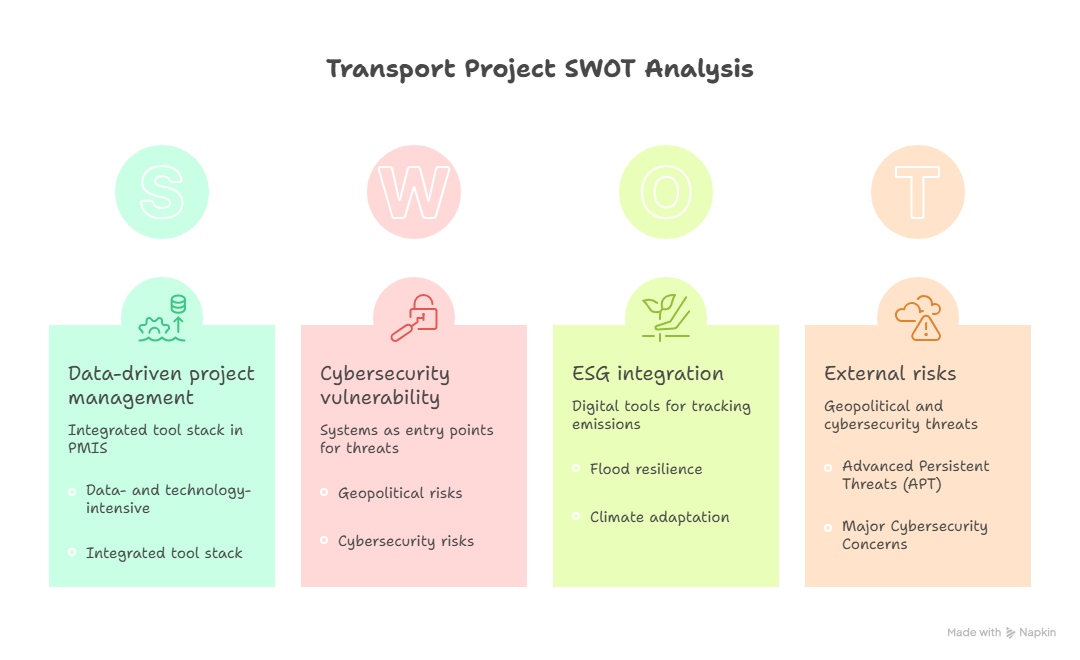
Modern highway projects are data- and technology-intensive, not just concrete and asphalt. PMOs overseeing Carpentaria-style programmes typically run integrated tool stacks like those profiled in Definitive Guide to Project Issue Tracking Software, Best Procurement Management Tools for Project Managers, and Top Contract Lifecycle Management Software Reviewed. Schedules, cost data, risk registers, and contract variations all feed into a single project management information system (PMIS).
ESG is no longer a “nice-to-have” section of the report; it is part of the project’s core justification. Flood resilience and climate adaptation are central benefits of upgrading regional highways. Concepts from Sustainability & ESG Project Management, Blockchain Gains Momentum in Project Management, and AI Adoption in Project Management Reaches Record Levels show how PMOs are starting to use digital tools to track emissions from plant, material sourcing, and resilience metrics – sometimes even exploring blockchain-backed assurance for ESG reporting.
On the risk side, geopolitical and cybersecurity risks now intersect physical infrastructure. Systems used to control traffic or collect telemetry can be entry points for threats like those discussed in Advanced Persistent Threats (APT) Mechanisms and Defence and Major Cybersecurity Concerns Prompt Project Management Software Overhaul. While Stage 3’s visible output is bitumen, the PMO behind it must treat data, access control, and system resilience with the same seriousness as physical safety.
For exam candidates following guides such as Complete 30-Day Study Plan to Ace Your CAPM Certification, Expert Guide to the CompTIA Project+ Certification Exam, and How to Pass the Six Sigma Green Belt Certification Exam, the Carpentaria project is a perfect context to practice integrating scope, schedule, cost, quality, ESG, and risk in a single coherent narrative.
5. Lessons for Certified Project Managers and Candidates
If you are already certified – or on your way via resources like Mastering the Certified Project Manager (IAPM) Exam, Certified Project Management Practitioner (CPMP) Complete Preparation Guide, or Expert Guide to the CompTIA Project+ Certification Exam – Stage 3 offers several concrete lessons:
Think in programmes, not projects. Carpentaria Stage 3 only makes sense when viewed alongside earlier stages and related corridor upgrades. This aligns with the portfolio thinking encouraged in Project Manager Salary Comparison by Certification and Global Project Management Salary Report 2025, where higher-paid roles sit at programme and portfolio levels.
ESG and resilience are now first-class scope elements. Upgrading drainage and raising embankments are no longer “technical extras”; they are climate adaptation measures tied directly to ESG commitments, as highlighted in Sustainability & ESG Project Management and Digital Transformation Across PMOs.
Contract strategy is risk management. The way risk is allocated in the Stage 3 contract (weather, ground, escalation) is as important as the risk register itself, reinforcing the need to grasp terminology in Essential Contract Management Terminology, Complete Guide to Project Procurement Terms, and Top 25 Risk Identification & Assessment Terms.
Infrastructure projects are perfect study material. If you are preparing for CAPM or PMP using guides like Complete 30-Day Study Plan to Ace Your CAPM Certification or Top 25 PMI-ACP Exam Questions Answered, building your own “case file” around the Carpentaria project – with mock WBS, risk registers, and stakeholder maps – is one of the fastest ways to make terminology stick.
6. FAQs: Carpentaria Highway Stage 3 and Project Management
-
Stage 3 showcases structured initiation: a clear business problem (freight inefficiency, safety, flood risk), options analysis, and a defined scope aligned with strategic objectives. This mirrors the concepts in Project Initiation Terms Every Project Manager Needs to Understand and Complete 30-Day Study Plan to Ace Your CAPM Certification. For exam prep, it helps you connect abstract terms like “business case”, “benefits realisation”, and “constraints” to a real corridor where travel-time savings, safety improvements, and resilience are all quantified in economic terms and become funding justifications.
-
Carpentaria Stage 3 surfaces weather risk, ground conditions, supply chain volatility, labour availability, regulatory approvals, and stakeholder opposition – each linked to the risk identification, analysis, and response terms you find in Top 25 Risk Identification & Assessment Terms and Comprehensive Project Risk Management Glossary. The contract’s allocation of responsibilities (who carries what risk) is itself a risk response strategy, illustrating why procurement and contract vocabulary from Essential Contract Management Terminology is inseparable from risk management.
-
The project’s seasonal constraints and resource limitations make critical path and float incredibly real. Activities such as earthworks, drainage, and surfacing must occur in specific sequences and weather windows. Concepts explained in Critical Path Method Terms Clearly Defined and Comprehensive Guide to Project Scheduling Terms 2025 show up in decisions about when to mobilise crews, where to place buffers, and how to respond when delays threaten flood season. If you can sketch a Gantt chart for Carpentaria with a credible critical path, your exam scheduling questions will feel much simpler.
-
Stage 3 demonstrates how tendering, evaluation, and contract choice translate risk and value priorities into binding terms. Authorities must decide between lump-sum, design-and-construct, or alliance-style arrangements, each with trade-offs outlined in Complete Guide to Project Procurement Terms and Essential Contract Management Terminology for Project Managers. The inclusion of escalation clauses, performance incentives, and variation mechanisms is a live reminder that contracts are not just legal documents; they are core project management tools that shape behaviour, cashflow, and risk-sharing.
-
Even if you work in IT, healthcare, or ESG programmes, Stage 3 offers a rich pattern library. The way it handles multi-stakeholder alignment, risk-laden schedules, and ESG outcomes mirrors challenges described in Sustainability & ESG Project Management, Digital Transformation Across PMOs, and AI Adoption in Project Management. You can map its WBS, risk register, and stakeholder plan into your domain, using the same terminology, then adapt duration, cost, and risk drivers.
-
To turn Carpentaria into an exam accelerator, pair it with: Top 100 Project Management Terms You Must Know, Comprehensive Project Risk Management Glossary, Critical Path Method Terms Clearly Defined, Complete Guide to Project Procurement Terms, and Complete Guide to Six Sigma Terms for Project Managers. Then layer in a certification-specific guide such as Complete 30-Day Study Plan to Ace Your CAPM Certification or Mastering the Certified Project Manager (IAPM) Exam to translate those insights into question-solving strategies.
