
Massachusetts Project Management Careers: Salaries, Employers & Certifications
Massachusetts is one of the best states in the US to build a serious project management career, but it is also one of the easiest places to get stuck. The pay can be strong, the employers are world class, and the projects are high impact. At the same time, hiring teams expect sharper delivery habits, stronger stakeholder management, and cleaner governance than many candidates realize. This guide shows you where the demand is, what salaries look like, which employers hire the most, and exactly which certifications move the needle in Massachusetts.

1) Why Massachusetts is a top tier state for project managers right now
Massachusetts rewards PMs who can operate in complexity. It is not just “lots of jobs.” It is the type of work. Biotech and life sciences move fast and carry regulatory risk. Healthcare systems demand change adoption, not just delivery. Financial services and insurance expect strong controls and governance. Higher education and public sector work requires disciplined procurement and stakeholder alignment. That mix creates opportunity for PMs who can run structured delivery while staying flexible.
This is why Massachusetts is a perfect match for hybrid execution. Many teams want predictability and speed at the same time, which is exactly the shift explained in hybrid project management and the broader changes covered in project management 2030. In practice, Massachusetts employers hire the PM who can translate strategy into a plan, then run delivery with a cadence that executives trust.
The second reason Massachusetts is different is how mature the conversation is around governance and portfolio clarity. Many organizations do not want “a PM who runs tasks.” They want a PM who protects decision quality, surfaces tradeoffs early, and builds reporting that executives actually use. If you understand the principles in the future role of the PMO and the future of project governance, your interviews become easier because you sound like the person who reduces chaos.
The third reason is tooling. Massachusetts employers are investing in better planning, better forecasting, and better automation. You do not need to sell “AI hype.” You need to show you can use modern systems to keep estimates honest, track risks, and maintain delivery rhythm. That is the real advantage described in AI and project management and more specifically in machine learning for estimation and scheduling.
If you want to win in Massachusetts, your positioning should be specific. Pick a lane, then prove delivery results inside that lane. “Biotech program PM.” “Healthcare implementation PM.” “Financial services governance PM.” “Software delivery PM.” The clearer your lane, the less your resume looks like a gamble.
2) Massachusetts PM salaries: realistic ranges and the levers that increase pay
Massachusetts compensation is strong because the work is high accountability. In Boston, project manager pay is commonly reported in a range that can start around the high five figures and push into the mid six figures depending on scope, industry, and seniority. For example, Indeed reports an average of about $113,613 for project managers in Boston with a low end near $79,105 and a high end near $163,174. Indeed ZipRecruiter reports a Boston average around $111,540. ZipRecruiter This is why you should treat “salary” as a strategy problem, not a guessing game.
If you want a stable baseline reference that is not tied to one city or one job board, the Bureau of Labor Statistics lists the median annual wage for project management specialists as $100,750 in May 2024. Bureau of Labor Statistics CareerOneStop shows Massachusetts wages for project management specialists with an hourly spread that implies a wide band across experience levels. CareerOneStop Translation, Massachusetts pays well, but the spread is large, so positioning matters.
Here are the levers that move your number up in Massachusetts.
Scope lever: program complexity beats task volume. Managing one complex cross functional program usually pays more than running many small projects. This is why portfolio thinking from future of PPM becomes a pay skill, not just a leadership concept.
Risk lever: regulated environments pay for control. Healthcare, life sciences, and financial services pay more when you can prove governance, control mapping, and audit readiness. That maps directly to future governance best practices and the maturity expectations in future PMO success.
Tooling lever: better forecasting earns trust. Teams pay more for PMs who can run forecasting with discipline, not wishful thinking. Tie your methods to future of PM software and use concepts from ML estimation and scheduling to describe how you reduce variance.
Industry lever: some lanes pay more by default. Glassdoor notes that top paying Boston industries can include aerospace and defense and financial services. Glassdoor You do not need to chase the highest paying lane, but you should understand the market so you do not underprice yourself.
Your salary story in Massachusetts should sound like this. “I reduce delivery risk. I protect decision quality. I deliver measurable outcomes. Here is the evidence.” That is how you get above the middle of the band.
3) Best Massachusetts employers for PM careers and how to choose the right one
A common mistake is chasing brand names without understanding what you are signing up for. In Massachusetts, the best employer is the one whose delivery environment matches your strengths. Some places reward governance and control. Some reward speed and iteration. Some reward stakeholder diplomacy. You need to pick the one that fits, then shape your resume to match.
Massachusetts has deep demand in life sciences and biotech project management, especially in the Boston area, with job markets consistently listing significant volume. Indeed Built In Boston also highlights life sciences and healthtech companies hiring for program and project management roles, including major names in biotech and pharma. Built In Boston This matters because those employers tend to value disciplined delivery, clean documentation, and the ability to manage vendors.
To choose the right employer, look at five filters.
Filter 1: delivery model. Are they truly agile, truly waterfall, or hybrid in practice. Most are hybrid, so make sure you can speak to hybrid execution with confidence using hybrid project management and project management 2030.
Filter 2: governance maturity. Do they have a functioning PMO or are they improvising. A mature PMO can accelerate your growth if you like structure. This is where the future PMO role becomes a career advantage because you understand what executives want from reporting.
Filter 3: product versus delivery. Some employers treat PMs like internal consultants. Others treat them as product adjacent execution leaders. Decide which environment fits you, then tailor your examples accordingly.
Filter 4: stakeholder density. Massachusetts has many matrix organizations. If you hate stakeholder management, you will burn out. If you are strong at alignment, it becomes your edge. Build this muscle through leadership concepts covered in future PM leadership.
Filter 5: tools and reporting cadence. The best jobs have clear rhythms, not constant fire drills. To assess this, ask about how they run reporting, how they manage budgets, and how they measure benefits. Align your questions to budget tracking tools and productivity software.
If you choose your employer using these filters, you stop wasting months in roles that look good on paper but slow your career.
4) Certifications that matter most in Massachusetts and how to choose the right one
Certifications do not replace experience. In Massachusetts, they reduce doubt. They signal that you understand structure, terminology, and professional standards. The key is choosing the certification that matches the lane you want.
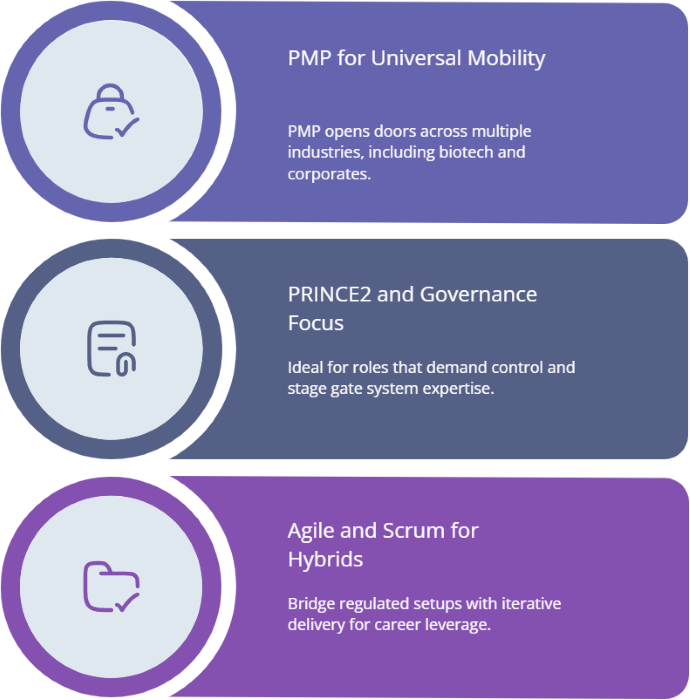
PMP is the most universal credential. It is the safest bet if you want mobility across biotech, healthcare, finance, and corporate PMO roles. If you are serious about PMP, do not wing it. Use a structured path like the ultimate PMP exam guide, then drill your weak areas with top PMP questions. If you need speed, build your timeline from the 30 day PMP study plan and lock performance on the actual day with the PMP exam day survival guide.
PRINCE2 is strong for control heavy environments. If you are targeting government, education, infrastructure, or organizations that love stage gates and formal documentation, PRINCE2 can be a powerful signal. Start by understanding fit using PMP vs PRINCE2, then pick the right level via PRINCE2 foundation vs practitioner. For preparation, follow the PRINCE2 exam guide and test readiness using PRINCE2 questions.
Agile and Scrum knowledge is still a career amplifier. Even in regulated environments, many teams run hybrid. Massachusetts employers often want a PM who can operate in both structured governance and iterative delivery. To stay ahead of where agile is going, understand the evolution described in scrum changes coming by 2027.
AI literacy is becoming a soft requirement. You do not need to claim deep technical skill. You do need to show you can use AI to improve planning quality, reporting speed, and risk detection. Anchor your language to AI impacts by 2030 and practical planning shifts from future PM software.
A simple decision rule works. If you want broad mobility, go PMP first. If your target lane is governance heavy, add PRINCE2. If your lane is software delivery, strengthen hybrid and agile fluency. Then reinforce all of it with strong tools knowledge, because Massachusetts hiring teams love PMs who can operationalize, not just talk.
5) How to land a Massachusetts PM role faster using a real pipeline strategy
Most candidates lose in Massachusetts because they search casually. They apply randomly, write generic resumes, and hope. That approach gets eaten alive because the market has too many qualified people. You need to run your job search like a project.
Step 1: Build a target list based on funded work. Use the matrix table and pick 25 to 40 employers that are clearly investing in modernization, compliance, scale, or product launches. Your list should include a mix of life sciences, healthcare, finance, tech, and public sector, but only if you can tell a credible story in each lane. Portfolio targeting is a PM skill, which is why the thinking in future of PPM is so relevant even for job seekers.
Step 2: Build three proof stories. Massachusetts hiring managers want evidence. Create three short stories, each built around outcomes and constraints. One story about delivery under time pressure. One story about stakeholder alignment in conflict. One story about risk management and governance. If you understand future of governance, you can tell these stories in a way that feels executive ready.
Step 3: Turn your resume into a trust document. Most resumes list responsibilities. That is weak. Replace “responsible for” with measurable outcomes, decision points, and delivery rhythm. Mention how you ran reporting cadence, how you tracked risks, and how you measured benefits. Tie your tooling to recognized categories like budget tracking tools, productivity software, and training readiness through PM training platforms.
Step 4: Prepare for the interview patterns Massachusetts loves. Many employers test how you think. Expect scenario questions on stakeholder conflict, scope changes, and risk escalation. Your answers should reference governance, portfolio tradeoffs, and method selection. That is why project management 2030 and future leadership styles are not theory, they are interview ammo.
Step 5: Use certifications as a momentum tool. If you are not certified yet, you can still compete if you show a credible timeline and plan. A strong approach is to state “PMP in progress” and back it with a structured system drawn from PMP exam prep software plus a clear schedule like the 30 day plan.
The goal is simple. You want recruiters to feel certainty when they read you. Massachusetts rewards PMs who reduce uncertainty. Make your job search prove that you do exactly that.
6) FAQs: Massachusetts project management careers
-
It depends on role scope, industry, and seniority. In Boston, multiple sources report averages around the low to mid $100k range, with higher levels pushing well above that. Indeed reports an average around $113,613 for Boston project managers. Indeed At the occupation level, BLS lists a median annual wage of $100,750 for project management specialists in May 2024. Bureau of Labor Statistics Use these as directional references, then focus on negotiation levers like scope, risk, and governance maturity.
-
Life sciences, healthcare, financial services, software and SaaS, education, and government modernization are consistently strong lanes. Biotech and life sciences PM listings in Massachusetts are also visible across major job markets. Indeed+1 The best lane for you is the one where your experience reduces risk and your proof stories match the projects being funded.
-
Yes, PMP is the most portable credential across Massachusetts industries, especially for PMO, program, and transformation roles. The bigger benefit is not the letters, it is the structure. Use a rigorous path like the PMP exam guide, reinforce with PMP questions, and run a timeline using the 30 day plan.
-
Choose PRINCE2 when you are targeting environments that prioritize stage gates, documentation, and controlled governance, such as public sector, education, and some infrastructure heavy organizations. Use PMP vs PRINCE2 to decide, then choose level through foundation vs practitioner.
-
Do not lead with generic PM statements. Lead with risk control and traceability. Show you can run vendor governance, maintain decision logs, and protect timelines without cutting corners. Ground your delivery narrative in governance principles from future governance and modern planning thinking from ML estimation.
-
Start with tools that help you run cadence and reporting. Budget tracking, dashboards, and planning workflows matter more than fancy features. Build your tool awareness using budget tracking software and productivity tools. Then deepen capability through PM training platforms.
-
Pick a lane, build proof stories, and attach a credible certification timeline. Massachusetts rewards specialization and clear positioning. Align your delivery story with hybrid methods, communicate executive ready governance using the PMO role evolution, and show modern planning literacy through AI and PM.
