
Predicting Key Project Management Trends in Healthcare for 2030
Healthcare project management is heading into a decade where delivery speed is not the advantage. Safe adoption is. Audit ready execution is. Clinician trust is. By 2030, the highest performing healthcare PMOs will feel less like a scheduling function and more like a risk, value, and change engine that can ship digital and clinical programs without breaking compliance, care quality, or staff morale. This article maps the trends that will matter most, the PMO capabilities that will separate winners from laggards, and the playbooks to deliver outcomes in a sector that punishes mistakes.

1) The Forces That Will Redefine Healthcare Project Management by 2030
By 2030, healthcare project work will be shaped by five pressure systems that most PMOs still treat as “constraints” instead of delivery inputs. The first is regulatory acceleration, where privacy, AI governance, cybersecurity expectations, and reporting obligations move faster than procurement cycles. That is why healthcare PMs who rely on generic governance templates get trapped in late stage rework, the same pattern described in broader enterprise restructures like middle management streamlining and new framework rollouts during reorgs. The shift forces PMOs to build compliance into intake, not bolt it on at go live.
The second force is clinical capacity stress. Staffing shortages do not just reduce headcount. They reduce tolerance for change. If your program plan assumes unlimited training time, champions, and overtime, your timeline is fiction. This is where healthcare delivery starts to mirror the budget and uncertainty realities covered in inflation driven budget pressure and economic uncertainty pushing agile demand. In 2030 healthcare, “agile” is not a buzzword. It is a survival pattern for overloaded teams.
Third is interoperability becoming a business model, not a technical goal. By 2030, payer, provider, pharmacy, lab, imaging, and remote monitoring ecosystems will expect data sharing as a default capability. That means your PMs need a delivery language that translates across domains. Glossary discipline becomes operational leverage, so keep a shared vocabulary like project initiation terms, top PM terms, and a consistent risk lexicon like the risk management glossary and risk identification terms. When clinicians, IT, vendors, and compliance teams define “done” differently, delivery dies in translation.
Fourth is cyber risk as a delivery tax. Healthcare is already a high value target. By 2030, projects that change identity, access, devices, or data flows will be treated like security programs, even if the business calls them “workflow improvements.” That trend aligns with the same enterprise direction seen in major cybersecurity concerns prompting software overhaul and broader digital transformation acceleration. The PMO must own secure by design checkpoints or accept a future of delays, emergency patches, and reputational damage.
Fifth is value based care discipline entering the PMO. In 2030, healthcare programs will be judged on measurable outcomes like reduced readmissions, lower total cost of care, and improved patient experience. If your PMO cannot connect a project to value, your funding gets cut, especially when boards are asking why PM is a growth engine, a theme echoed in PM as a driver of economic growth. This forces a stronger benefits framework, tighter scope control, and sharper prioritization than most healthcare PMOs use today.
2) The 2030 Trend Stack: What Will Win Funding, Attention, and Executive Air Time
In healthcare, the “top trends” list is useless unless it explains why certain programs get funded while others stall. By 2030, executives will back projects that reduce enterprise risk, increase capacity, or improve reimbursement outcomes. Everything else is “nice to have.” That is why delivery leaders should study how organizations reallocate work during disruption, as seen in job cuts reshaping structures, or how strategic build outs create new oversight bodies like a new PMO for factory expansion. Healthcare will do the same, but with care delivery priorities.
First, AI enabled operations will move from pilots to platform. That includes ambient documentation, clinical coding support, scheduling optimization, and prior authorization triage. The trend is not “use AI.” The trend is “manage AI like a regulated product.” PMOs that do not add AI risk gates will lose time in legal, compliance, and post incident recovery. Use structured delivery practices from core frameworks and choose a backbone that fits your environment, whether that means aligning teams through certification level rigor like PMP vs PRINCE2 selection, or tightening exam grade planning behaviors like PMP exam day survival discipline and the PRINCE2 exam guide.
Second, cyber resilience programs will be treated as clinical safety initiatives. A ransomware event in 2030 will be seen as an avoidable patient safety risk, not just an IT incident. That is why healthcare PMs must internalize security aligned delivery patterns found in cybersecurity overhaul drivers and add technical risk language into every plan using the risk glossary and risk term list. If your RAID log cannot capture a security dependency, your schedule is lying.
Third, interoperability delivery becomes a portfolio engine. By 2030, the projects that make data usable across care settings will unlock outcomes, cost control, and automation. This is why software investment continues to surge in pressured environments, a pattern reflected in rising investment in PM software and AI adoption trend lines. The PMO has to become competent in integration sequencing, data governance, and cross vendor coordination, or the organization will keep funding new tools that never become an operating system.
Fourth, portfolio rationalization will finally get teeth. Healthcare organizations are famous for running too many initiatives at once, then wondering why nothing lands cleanly. By 2030, constrained capital and staffing will force ruthless prioritization. This is where basic PM language becomes weaponized for clarity, using project initiation terms, budgeting terms, and cost management terms. If the PMO cannot speak cost, it cannot kill projects early.
Fifth, ESG and sustainability reporting becomes operational, not reputational. Hospitals are energy intensive, supply chain heavy, and community visible. By 2030, sustainability requirements will show up as procurement thresholds, facility project gates, and reporting needs. PMs can borrow playbooks from broader sustainability and ESG project management shifts and adapt them to healthcare realities like supplier compliance, waste streams, and facility lifecycle costs.
3) The Healthcare PMO of 2030 Will Look More Like a Delivery Product Team
Most healthcare PMOs fail in the same two ways: they either become a bureaucracy that slows teams down, or they become a reporting factory that has no influence over outcomes. The 2030 PMO will be neither. It will behave like a product team for delivery itself, building reusable assets that make projects safer, faster, and more predictable. This is how high maturity PMOs operate in high pressure environments, similar to the organizational shifts behind major programs like Crossrail planning momentum or complex redevelopment like the Centennial Yards mega project.
Start with intake that captures clinical reality, not just scope. A 2030 healthcare intake form needs data sensitivity, patient safety impact, operational readiness, training burden, and downtime tolerance. If you do not capture that early, you pay for it later through clinician pushback, unsafe workarounds, and delayed adoption. This is where PMO operations can use structured language and definitions from team building terminology, HR management terms, and agile delivery patterns referenced in global agile demand signals. Your governance becomes lighter because your inputs are stronger.
Next, build risk based delivery lanes. Not every healthcare project needs the same ceremony, but high risk change always needs the same proof. By 2030, PMOs will route projects into lanes like “clinical workflow change,” “data exchange change,” “identity and access change,” or “device and network change.” Each lane has required checkpoints, templates, and sign offs. This reduces cycle time because teams are not negotiating governance from scratch. Use risk framing from risk identification terms and financial discipline from budgeting terms to keep approvals tied to consequence, not hierarchy.
Then, shift the PMO from status reporting to delivery enablement. In 2030, executives will not tolerate “green until it is red.” They will expect early warning systems. That requires better leading indicators such as clinical champion coverage, training completion quality, defect escape rate, integration throughput, and security findings closure. This is why robust tooling investment trends exist, as seen in PM software investment surges and broader digital transformation acceleration. PMOs must own the instrumentation, not just the slides.
Finally, the PMO must become a negotiation engine for capacity and prioritization. If the organization is overloaded, perfect plans still fail. In 2030, healthcare PMOs will enforce fewer parallel initiatives, clearer sequencing, and more honest resource trade offs. Borrow discipline from environments adapting to stress, like UK construction navigating downward trends and economic pressures reshaping delivery behaviors. Healthcare is different, but the portfolio math is the same.
4) 2030 Delivery Playbooks: How the Best Healthcare Programs Will Actually Ship
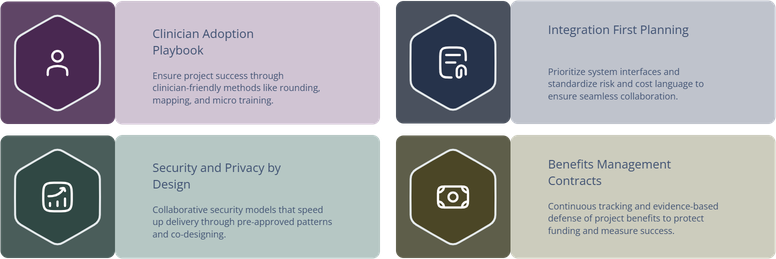
By 2030, healthcare projects that succeed will feel boring from the outside because they will reduce surprise. The goal is not to “move fast.” The goal is to move in a way that does not trigger clinical backlash, compliance escalation, or security shutdown. That starts with the clinician adoption playbook: early champion mapping, workflow co design, micro training, and post go live rounding. If you skip rounding, you never see the silent failure where staff revert to old habits. This is classic change risk, which is why PMs should keep a tight language system for roles and responsibility like essential Scrum roles and team behavior foundations from team building terminology.
The second playbook is integration first planning. In healthcare, the critical path is often interfaces, not features. A 2030 PM plan should explicitly list each upstream and downstream system, the data contract, the ownership, and the test strategy. This becomes easier when your PMO standardizes risk language using the risk glossary, standardizes cost language using cost management terms, and standardizes initiation clarity using project initiation terms. Without shared language, every integration becomes a custom negotiation.
The third playbook is security and privacy by design, where security is not a late stage reviewer but a co designer of the delivery path. This is not theoretical. The fastest teams in 2030 will be the ones with pre approved patterns for identity, encryption, logging, and incident response. That mindset mirrors enterprise shifts described in cybersecurity driven overhauls and the broader story of AI adoption at record levels, where governance becomes a speed enabler when it is built into the system.
The fourth playbook is benefits management as a living contract. Healthcare projects fail funding reviews because benefits are written once, then never measured. In 2030, benefits are tracked weekly and defended with evidence. Use a benefits hypothesis format, define the measurement source, set a confidence range, and assign an owner who will live with the outcome. This is exactly how PM becomes a strategic lever, aligned with narratives like PM driving growth and economic pressure forcing better methods. When a CFO is cutting spend, your dashboard is your protection.
5) What to Measure in 2030: The Metrics That Will Separate High Maturity Healthcare PMOs
A 2030 healthcare PMO will be judged less by whether projects “finish” and more by whether they land cleanly. That requires a measurement model that tracks outcomes, adoption, and risk posture. Start with a capacity metric set: clinician time reclaimed, patient throughput, wait time reduction, and training hours per role. If you cannot quantify capacity impact, you cannot defend prioritization. This is where budgeting rigor matters, and why PMs should speak the language in project budgeting terms and cost management terms. Healthcare executives fund capacity, not ambition.
Next, track delivery health leading indicators. Lagging indicators like “percent complete” are useless when adoption collapses at the finish line. Better leading indicators include integration throughput, defect escape rate, unresolved security findings, workflow variance, and champion coverage. Tooling matters here, which is consistent with trends like software investment surges and digital transformation acceleration. If your PMO cannot instrument delivery, it will always report problems too late.
Then, measure risk posture as part of performance. In 2030 healthcare, risk is not a sidebar. It is the delivery reality. Track audit readiness, privacy incidents, security closure time, downtime exposure, and critical dependency stability. Use standardized risk language and processes from the risk management glossary and the risk identification term set to keep reporting consistent across departments. When leadership asks “how exposed are we,” you need an answer that is comparable across programs.
Finally, measure benefits realization in a way finance respects. In healthcare, benefits are often indirect, so you must translate them into measurable proxies. Reduced documentation time translates to more patient visits. Better scheduling translates to fewer no shows. Cleaner data translates to fewer denials. If your PMO cannot create that chain, it will lose funding to projects with easier narratives. This is why mature frameworks and discipline matter. Teams that train toward high standards like PRINCE2 practitioner selection and execution discipline like the CAPM study plan tend to bring sharper measurement habits into complex environments.
6) FAQs: Predicting Healthcare Project Management Trends for 2030
-
The biggest shift will be treating delivery as a regulated operating system, not a set of temporary initiatives. By 2030, healthcare PMs will be expected to design governance that accelerates work, not slows it, similar to how organizations adopt new structures during major changes like framework rollouts in reorgs. The PMO will own reusable templates for risk gates, integration planning, and clinical change adoption. The teams that win will reduce surprise and rework by capturing clinical, privacy, and security realities at intake using shared definitions like project initiation terms.
-
AI turns many “workflow projects” into governance projects. By 2030, planning must include model ownership, monitoring, bias checks, incident response, and clinical accountability. The risk is not just technical failure. The risk is loss of trust, safety incidents, or compliance escalation. Mature PMOs will embed AI specific gates the same way organizations respond to AI adoption at record levels. Strong PMs will also standardize risk language using the risk glossary so AI risks are communicated consistently across clinical, legal, and IT teams.
-
Because build happens in controlled conditions and go live happens inside real clinical pressure. If training, workflow change, downtime planning, and adoption support are weak, clinicians default to workarounds and the project “succeeds” on paper while failing in reality. The 2030 approach is to treat adoption as a deliverable with ownership, metrics, and post go live rounding. This requires disciplined role clarity like Scrum roles explained and structured team behaviors supported by team building terminology. When adoption is planned like an engineering stream, outcomes improve fast.
-
Funding will follow capacity, risk reduction, and reimbursement aligned outcomes. Projects that reduce denial rates, improve throughput, shorten wait times, or harden cyber posture will win. Projects that cannot prove measurable value will stall in governance and get cut during portfolio review cycles. This pressure mirrors broader patterns like inflation impacting project budgets and economic uncertainty driving agile demand. PMs who can translate benefits into financial language using budgeting terms will defend funding better.
-
By standardizing secure patterns and making security a design partner, not a late stage blocker. In 2030, the fastest healthcare teams will use pre approved controls, clear escalation paths, and security checkpoints that map to risk severity. That approach aligns with the logic behind cybersecurity prompted overhauls. The PMO should track security findings like delivery work, with SLAs, owners, and burn down. Use shared language from the risk identification terms so leadership understands exposure in plain terms, not technical jargon.
-
Stop pretending everything is priority one. In 2030, portfolio success will come from fewer parallel initiatives, clearer sequencing, and enforced capacity constraints. The PMO must own a kill switch process, tie every project to measurable value, and require realistic resourcing before approval. This is the same logic that emerges when organizations restructure delivery under pressure, as seen in efficiency driven structure changes. Use consistent cost language from cost management terms and prioritize projects that protect revenue, reduce risk, or reclaim capacity.
-
Hybrid will dominate, but not in a vague way. Healthcare will use adaptive planning for uncertain work like digital front door, analytics, and integration layers, while using structured stage gates for high risk work like EHR cutovers, device connectivity, and privacy sensitive programs. This matches the broader trend of rising agile demand while still requiring strong governance rigor. Many teams will align methods to training and standards, choosing a foundation such as PMP vs PRINCE2 based on their environment and constraints. The winning pattern is not the method. It is choosing the right controls for the risk.
