
Preparing for the PMP exam in 2027 or 2028 requires more than memorizing project management terminology. A realistic 180-question PMP exam simulator tests how you handle stakeholder conflicts, shifting priorities, financial pressure, regulatory obligations, and complex delivery decisions under time constraints. This guide combines the current PMP examination domains, a full-length timed mock exam, a practical decision matrix, and targeted recovery strategies. Use it alongside PMP preparation resources and proven exam success techniques to identify exactly what needs improvement before exam day.
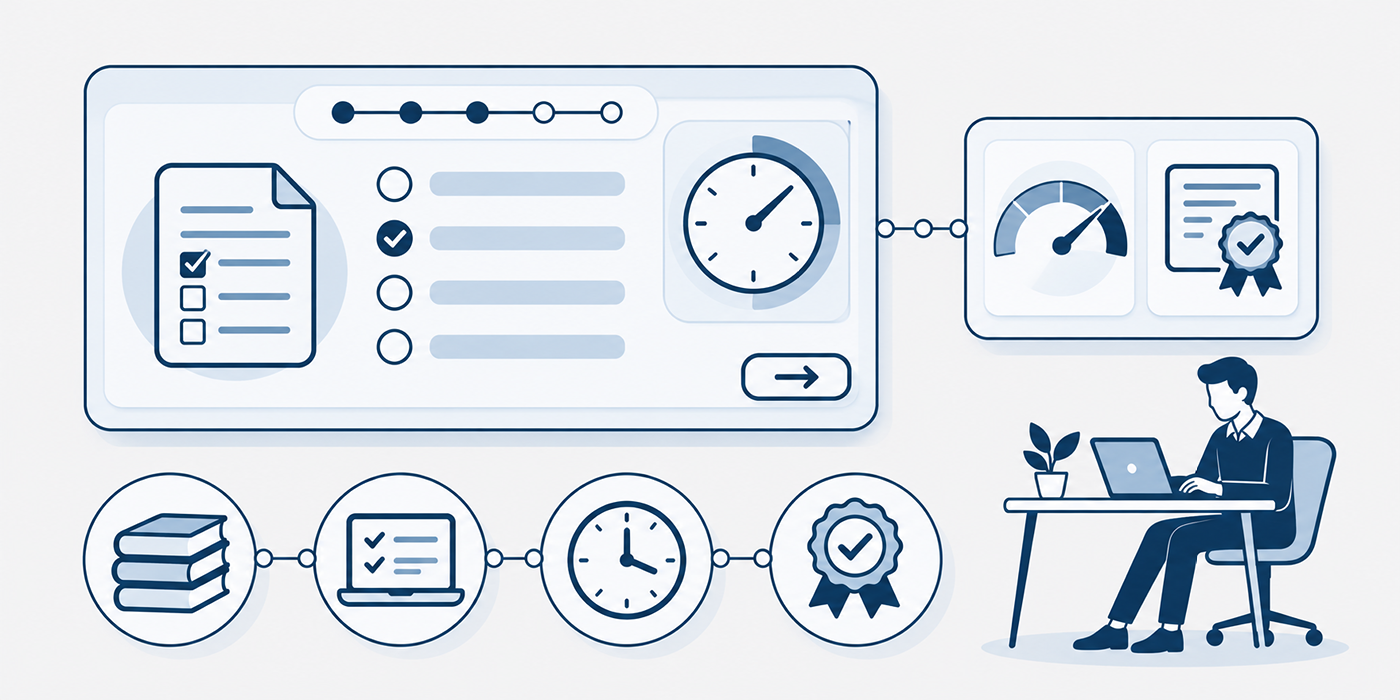
1. PMP Exam 2027-2028: Understand the Latest Exam Structure and Requirements
The most important preparation decision for 2027–2028 is choosing the correct examination blueprint. PMI introduced a major PMP examination update on July 9, 2026, increasing the emphasis on business value, organizational strategy, AI, sustainability, and realistic project scenarios. As of November 2026, PMI has published no replacement blueprint specifically for 2027 or 2028. The July 2026 Exam Content Outline therefore provides the current foundation for candidates planning future attempts.
The official examination currently includes 180 questions, 240 minutes, and two 10-minute breaks, with 170 scored questions and 10 unscored pretest items. Candidates should review the latest PMP exam domain breakdown, compare PMP preparation strategies, and evaluate exam preparation tools against that specification. Confirm the outline again before booking a 2027 or 2028 examination date.
The three examination domains
People: 33% of the examination. This domain evaluates leadership, conflict resolution, stakeholder engagement, collaboration, team development, and interpersonal judgment. Strong candidates understand how to support team autonomy while protecting accountability. Useful preparation includes Agile project management leadership, transitioning from traditional to Agile delivery, and responsibility assignment methods.
Process: 41% of the examination. Questions cover project planning, delivery, scope management, procurement, quality, schedule control, risk responses, and performance measurement. Expect situations where several technically legitimate actions compete, requiring you to recognize what should happen first. Practice earned value calculations, project management templates, and project governance controls to understand their operational application.
Business Environment: 26% of the examination. This domain carries significantly more weight than it did before the 2026 revision, when it represented 8%. It evaluates regulatory compliance, business outcomes, organizational change, benefits realization, and the connection between project decisions and strategic objectives. Candidates should study cybersecurity project management, AI-assisted project workflows, predictive project analytics, and executive project governance.
What makes a 2027–2028 PMP mock exam realistic?
The current blueprint distributes approximately 40% of questions across predictive approaches and the remaining 60% across Agile/adaptive and hybrid approaches. Each delivery approach can appear within any of the three examination domains. Candidates familiar with SAFe Agile practices, Scrum scaling methods, or traditional project delivery must recognize when each method fits the specific scenario.
A strong simulation should also challenge candidates with case studies, multiple-response questions, calculations, governance dilemmas, and ambiguous decision sequences. PMI's current examination includes interactive and graphics-based formats, so a text-based practice simulator should be supplemented with representative visual question practice.
For a 180-question mock, an approximate practice allocation is 60 People questions, 74 Process questions, and 46 Business Environment questions. This gives candidates a practical distribution close to the published percentages. Reviewing common PMP examination mistakes, realistic candidate experiences, and project decision frameworks helps translate that distribution into targeted preparation.
The following HTML reference matrix identifies 30 critical exam decision patterns, including the strongest response, the evidence to examine, and the mistakes that typically lead candidates toward weaker answers.
| Exam Domain | Scenario Trigger | Best PMP Decision | Evidence to Examine | Common Wrong Answer |
|---|---|---|---|---|
| People | Two stakeholders dispute decision authority | Clarify accountability and delegated approval rights. | Responsibility matrix and governance charter. | Allowing both stakeholders to approve independently. |
| People | A team member repeatedly misses commitments | Investigate constraints and agree on corrective support. | Capacity, blockers, and performance trends. | Escalating immediately without investigation. |
| People | The sponsor demands an inaccurate green status | Communicate verified performance and recovery options. | Forecast variance, risks, and decision log. | Concealing unfavorable information. |
| People | Senior specialists disagree about implementation | Facilitate resolution using technical and business evidence. | Alternatives, dependencies, and working agreements. | Imposing an unsupported solution. |
| People | A remote team stops reporting problems | Restore communication and psychological safety. | Issue reporting and team feedback. | Assuming silence means delivery is healthy. |
| People | A functional manager reassigns a key specialist | Negotiate capacity and reassess project commitments. | Resource availability and critical dependencies. | Continuing the original schedule unchanged. |
| People | A stakeholder rejects a completed deliverable | Review acceptance criteria and investigate the gap. | Requirements baseline and acceptance evidence. | Declaring completion based on team effort. |
| People | An important expert plans to leave | Arrange validated knowledge transfer and cross-training. | Knowledge coverage and successor competence. | Saving documents without verifying understanding. |
| People | Executives ignore detailed status reports | Present exceptions, consequences, and decisions required. | Approval turnaround and unresolved issues. | Increasing report length without changing relevance. |
| People | The Agile team consistently overcommits | Use actual capacity and throughput to improve planning. | Completed work, carryover, and cycle time. | Mandating overtime for every iteration. |
| Process | Requirements exist across disconnected emails | Establish traceability and agreed acceptance criteria. | Approved requirements and change history. | Relying on verbal agreement. |
| Process | A sponsor requests a major scope expansion | Evaluate impacts through the applicable change process. | Cost, schedule, benefits, and approval authority. | Starting implementation before approval. |
| Process | A vendor claims completion but requests extra payment | Verify contractual terms and accepted deliverables. | SOW, acceptance record, and change orders. | Approving an invoice based on claims alone. |
| Process | An external API dependency slips | Assess downstream exposure and activate a response. | Dependency dates, contingency, and critical path. | Assuming supplier commitments are guaranteed. |
| Process | CPI falls to 0.80 | Validate cost performance and revise the final estimate. | EV, AC, CPI, and EAC assumptions. | Assuming the original budget remains achievable. |
| Process | SPI is below 1.00 | Investigate schedule variance and dependency impact. | EV, PV, critical path, and completion forecast. | Assuming every activity is equally delayed. |
| Process | Forecast excludes committed supplier costs | Reconcile actuals, accruals, and outstanding obligations. | Purchase orders and remaining cost estimates. | Equating paid invoices with total project cost. |
| Process | Quality defects recur after every release | Investigate root cause and improve prevention. | Defect recurrence and rework patterns. | Increasing inspection without correcting causes. |
| Process | A critical path activity is delayed | Recalculate float and assess recovery options. | Network logic and schedule constraints. | Accelerating unrelated noncritical work. |
| Process | A hybrid program requires fixed regulatory milestones | Combine formal approval gates with iterative delivery. | Compliance evidence and increment acceptance. | Forcing one methodology onto all work. |
| Process | Multiple projects compete for shared resources | Prioritize and sequence work using actual capacity. | Utilization, bottlenecks, and portfolio priorities. | Overallocating specialists indefinitely. |
| Process | A project reaches deployment without handover | Verify operations ownership, training, and support readiness. | Transition checklist and operational acceptance. | Closing the project at technical completion. |
| Business Environment | New privacy regulations affect project data | Determine applicability and implement required controls. | Compliance obligations and gap assessment. | Deferring privacy review until launch. |
| Business Environment | An AI system generates unreliable recommendations | Assess data quality, bias, validation, and human oversight. | Error rates, testing evidence, and control ownership. | Assuming automation improves every decision. |
| Business Environment | A cybersecurity threat becomes an active incident | Activate the approved incident response process. | Containment status and response responsibilities. | Treating an ongoing incident as a hypothetical risk. |
| Business Environment | A requested change exceeds approval limits | Escalate through authorized governance channels. | Delegated authority and approval thresholds. | Accepting informal authorization. |
| Business Environment | A regulatory obligation changes mid-project | Evaluate impact and update compliance requirements. | Effective dates and readiness evidence. | Waiting until final acceptance testing. |
| Business Environment | A low-cost option creates higher environmental costs | Compare lifecycle cost, sustainability, and business value. | Energy consumption and operating costs. | Selecting solely by initial purchase price. |
| Business Environment | Deliverables are completed but expected benefits decline | Reassess outcomes, assumptions, and benefits ownership. | Benefits KPIs and business-case measures. | Equating completed scope with successful value delivery. |
| Business Environment | Employees reject a newly deployed business process | Investigate adoption barriers and coordinate support. | Actual usage and operational performance. | Treating training attendance as successful adoption. |
2. Take the Full 180-Question Timed PMP Mock Exam for 2027-2028
A full-length PMP exam simulator for 2027-2028 evaluates your ability to make accurate project decisions under time pressure. The current exam format includes 180 questions in 240 minutes, averaging 80 seconds per question. Effective preparation combines PMP study resources, exam success strategies, and common mistake analysis.
Practice Under Real Examination Conditions
Complete the mock in one sitting, using the permitted breaks and avoiding outside assistance. Monitor your pacing, flag uncertain answers, and review difficult scenarios before completing each section. Apply time-management techniques and strengthen Agile decision-making to handle complex situations efficiently.
Analyze Your Performance by Domain
Review your results across People (33%), Process (41%), and Business Environment (26%). Identify whether errors come from missing knowledge, poor judgment, calculations, or time pressure. Use earned value practice, governance frameworks, and PMP domain guidance to address specific weaknesses.
Turn Mock Exam Results Into Higher Scores
After each attempt, review incorrect answers and correct guesses. Explain why the best answer succeeds and why competing options fail. Retest weak concepts using unfamiliar scenarios rather than repeating memorized questions. Consistent performance across fresh mock exams, supported by accurate reasoning and reliable pacing, provides stronger evidence of readiness than a single high score.
3. Master the PMP Decision-Making Method That Separates Strong Answers From Distractors
Most difficult PMP scenarios contain multiple plausible options. The challenge is identifying the action that best fits the problem, its timing, and the project manager's authority. Candidates who rely on memorized phrases such as "always escalate" or "always collaborate" risk choosing an action that is reasonable in general but inappropriate in context. Effective project governance leadership, Agile team coordination, and PMP exam preparation require a more disciplined approach.
Step 1: Identify the actual decision
Read the final question first to determine whether you must select the first action, best response, preventive measure, or most effective resolution. Then identify the central problem in the scenario.
For example, a team complaining about delivery delays may be experiencing insufficient resources, unclear approval authority, or unresolved dependencies. Each requires a different intervention. Use responsibility mapping, project governance processes, and critical project documentation to distinguish the underlying causes.
Step 2: Determine whether the problem is a risk, issue, or change
A risk describes uncertainty that may affect future objectives. An issue is already occurring. A proposed change may require impact analysis and formal approval. These categories often determine the correct next action.
For instance, a potential cybersecurity vulnerability may justify assessment and risk treatment. An active data breach demands an incident response consistent with organizational procedures. A new security feature outside an approved baseline may require change authorization. Review cybersecurity management trends, future cybersecurity responsibilities, and project governance procedures to strengthen these distinctions.
Step 3: Identify the correct decision authority
Project managers coordinate decisions within delegated authority. Product owners, sponsors, change control boards, functional managers, and regulatory authorities may control different decisions. The strongest answer respects those boundaries while preventing unnecessary delay.
If a sponsor proposes a substantial scope expansion, assess the impact and follow the approved governance mechanism. If an Agile product owner reprioritizes a backlog within authorized limits, a different process may apply. Agile career development, Scrum scaling practices, and organizational governance principles can help clarify those differences.
Step 4: Eliminate actions that create avoidable damage
Weak answers frequently introduce a second problem while addressing the first. Examples include punishing an employee before investigating obstacles, implementing unapproved changes, concealing performance data, or escalating routine disagreements prematurely.
A stronger decision considers consequences for stakeholders, compliance, team trust, project objectives, and business value. Practice this reasoning through project leadership scenarios, change-control fundamentals, and common PMP mistake analysis.
Step 5: Explain why the second-best answer loses
After selecting an answer, identify the strongest alternative and explain precisely why it is inferior. The deciding factor might be timing, missing evidence, unnecessary escalation, inappropriate authority, or failure to protect business value.
Suppose a vendor misses a major milestone. One answer immediately terminates the contract, another accepts the delay, and a third evaluates contractual commitments, schedule exposure, and recovery options before taking authorized action. The third response is usually stronger when the facts do not establish grounds for immediate termination.
Build these distinctions into scenario-based PMP preparation, project governance practice, and risk-focused project management. Over time, you will develop faster recognition of the decisive facts that make one response superior.
4. Analyze Your PMP Mock Exam Results and Identify the Weaknesses That Actually Matter
A single percentage rarely explains whether a candidate is ready for the PMP exam. Your score may conceal a serious weakness in one domain, excessive time spent on particular question types, or repeated mistakes involving project governance. Effective preparation requires connecting every incorrect answer to a specific learning need. Use the PMP domain breakdown, exam preparation techniques, and common candidate mistakes to create a focused review process.
Separate domain performance from overall performance
Consider a hypothetical candidate who answers 126 of 180 questions correctly, producing a 70% mock score. Their domain results are:
People: 49 correct out of 60.
Process: 51 correct out of 74.
Business Environment: 26 correct out of 46.
The candidate's greatest weakness is Business Environment, followed by Process. Repeating general leadership preparation would consume study time that could be directed toward business governance, cybersecurity risks, and strategic project outcomes.
Investigate whether Business Environment errors result from missing knowledge or incorrect judgment. A candidate may understand regulatory compliance but struggle to distinguish immediate containment from routine risk assessment. Another may recognize benefits realization terminology yet fail to identify who owns the expected business outcome. Each problem requires different practice.
Categorize the underlying cause of every error
Use five categories when reviewing missed questions: knowledge gap, scenario misinterpretation, authority confusion, calculation error, and time-pressure error.
A knowledge gap requires studying the missing principle. Scenario misinterpretation requires learning to isolate decisive facts. Authority confusion requires understanding who may approve, prioritize, or escalate. Calculation errors require both numerical practice and interpretation. Time-pressure errors require realistic timed repetition.
Connect these categories to earned value calculations, RACI accountability, project management templates, and Agile delivery principles.
Interpret CPI, SPI, and EAC correctly
Suppose a project reports an Earned Value of $240,000, Actual Cost of $300,000, Planned Value of $280,000, and Budget at Completion of $500,000.
CPI = EV ÷ AC = 0.80. This indicates the project is earning $0.80 of budgeted value for every $1 spent.
SPI = EV ÷ PV ≈ 0.86. This indicates earned value is below the planned level at the reporting date.
If current cost performance is expected to continue, EAC = BAC ÷ CPI = $625,000. This represents a projected $125,000 overrun against the original budget.
However, EAC depends on forecasting assumptions. If the past cost variance was exceptional and future work can proceed as originally estimated, a different forecast method may be appropriate. Candidates should compare assumptions instead of selecting a formula automatically. The earned value management calculator, predictive analytics guidance, and PMP preparation resources can help develop that judgment.
Establish evidence-based readiness targets
PMI does not publish a universal passing percentage such as 70% or 80%. A practical personal study target is consistent performance around 80% or higher on several fresh, challenging practice sets, supported by accurate reasoning, balanced domain results, and reliable timing. That threshold is a preparation benchmark rather than an official passing standard.
Review PMP success experiences, PMP retake recovery plans, and common exam failure patterns to understand why consistent reasoning matters more than one unusually high mock score.

5. Follow a 14-Day PMP Preparation Plan for 2027-2028 Exam Readiness
Candidates frequently spend their final weeks reading familiar material because it feels productive. Targeted practice offers greater value when the real problem is repeated decision-making mistakes. Use a structured 14-day schedule to identify weak areas, rehearse corrections, and demonstrate improvement under timed conditions.
Days 1–2: Establish your baseline
Complete a full 180-question mock exam without outside assistance. Review the domain score, flagged answers, unanswered questions, and questions consuming disproportionate time. Categorize every incorrect response by root cause.
Start with the PMP domain requirements, compare real examination preparation experiences, and select PMP study resources that directly address your two weakest categories.
Days 3–5: Repair recurring conceptual mistakes
Complete 20–30 unfamiliar scenario questions each day. After every incorrect answer, document why the preferred response is better than the strongest alternative.
If you repeatedly confuse approval responsibilities, practice RACI-based decision mapping and project governance structures. If you struggle with Agile scenarios, strengthen Agile leadership principles and hybrid project delivery. If calculations are the obstacle, practice using the earned value management calculator, then repeat the problems independently.
Days 6–8: Prioritize business-focused scenarios
Concentrate on Business Environment questions covering compliance, organizational change, business benefits, AI governance, sustainability, and incident response. In every case, identify the decision owner, applicable control, and intended business outcome.
Combine cybersecurity project management, AI project management workflows, predictive project analytics, and senior governance decision-making to build practical context for these questions.
Days 9–11: Train endurance and time control
Complete three timed 60-question practice sessions using unseen scenarios. Track response times and the number of questions flagged. Pay particular attention to the final 15 questions of each session, when concentration may decline.
Candidates transitioning from technical IT roles may need more practice with stakeholder judgment, while professionals coming from business analysis may need additional exposure to leadership and delivery-accountability questions. Use PMP time-management strategies and exam mistake prevention techniques to refine your pacing.
Days 12–14: Validate performance and prepare for the examination
Take a fresh full-length mock exam and compare performance against Day 1. Examine domain changes, reduction in recurring mistakes, timing consistency, and your ability to explain difficult answers.
On the final day, review your error log and essential formulas. Avoid beginning large new study topics immediately before the exam. Confirm scheduling requirements, identification procedures, and current exam policies through PMI's official website.
Candidates planning to take the exam in 2028 should recheck the Exam Content Outline for subsequent updates. Continue using PMP certification preparation resources, project governance learning, and PMP success techniques while maintaining a record of newly issued PMI guidance.
The goal is measurable improvement in how accurately and efficiently you make project management decisions. When your results demonstrate stable reasoning across unfamiliar scenarios, your mock examination has delivered meaningful preparation value.
6. FAQs: PMP Exam Simulator 2027-2028
-
Based on the latest published examination blueprint, the PMP exam contains 180 questions and lasts 240 minutes, with two 10-minute breaks. The three domains are People (33%), Process (41%), and Business Environment (26%). PMI's July 2026 update remains the latest confirmed major examination revision as of November 2026. Candidates should check PMI's official PMP certification page for subsequent changes and use APMIC's PMP exam domain guide when planning their studies.
-
A consistent 80% or higher on difficult, unfamiliar practice questions can serve as a useful personal preparation target. PMI does not publish a fixed passing percentage, and mock exam scores cannot guarantee certification success. Question difficulty, reasoning accuracy, confidence, and performance across all three domains provide a more meaningful assessment. Combine PMP success strategies with exam mistake analysis to measure genuine readiness.
-
PMI periodically updates certification examinations to reflect professional practice. A separate PMP examination blueprint for 2028 had not been announced as of November 2026. Candidates should prepare using the current outline and verify any future changes before booking. Focus on transferable capabilities including governance leadership, Agile delivery, AI project workflows, and risk management.
-
Two or three full-length exams using sufficiently different question sets can provide useful evidence of readiness when supported by targeted practice. The first establishes your baseline, the second evaluates corrections, and the third tests consistency under examination conditions. Candidates with repeated weaknesses may benefit from additional domain-specific sessions. Review PMP preparation resources, candidate success experiences, and retake recovery methods before increasing full-mock frequency.
-
Identify the decision requested, determine whether the situation describes a risk, issue, or proposed change, and establish the relevant approval authority. Eliminate options that bypass required evidence or create avoidable harm. Finally, compare the strongest remaining answers by timing and business impact. RACI responsibility mapping, project governance practices, and PMP exam mistake guidance provide useful foundations.
-
The current examination blueprint allocates approximately 40% of questions to predictive approaches, with the remaining 60% divided between Agile/adaptive and hybrid approaches. These methods appear across all examination domains. Candidates must understand the differences between traditional change control, iterative delivery, backlog prioritization, and mixed governance arrangements. Study Agile project management career development, SAFe Agilist concepts, and Scrum scaling techniques for practical context.
