
A project can appear on schedule while unresolved dependencies, untested assumptions, and emerging risks quietly threaten delivery. A well-managed RAID log exposes these problems before they become expensive failures. This guide provides a practical RAID log template, 28 completed examples, risk-scoring methods, escalation rules, and a repeatable review process. You will learn how to connect RAID records with project governance, responsibility assignments, performance measurement, and project management templates to protect deadlines, budgets, and stakeholder commitments.
1. What Is a RAID Log, and How Does It Prevent Project Failure?
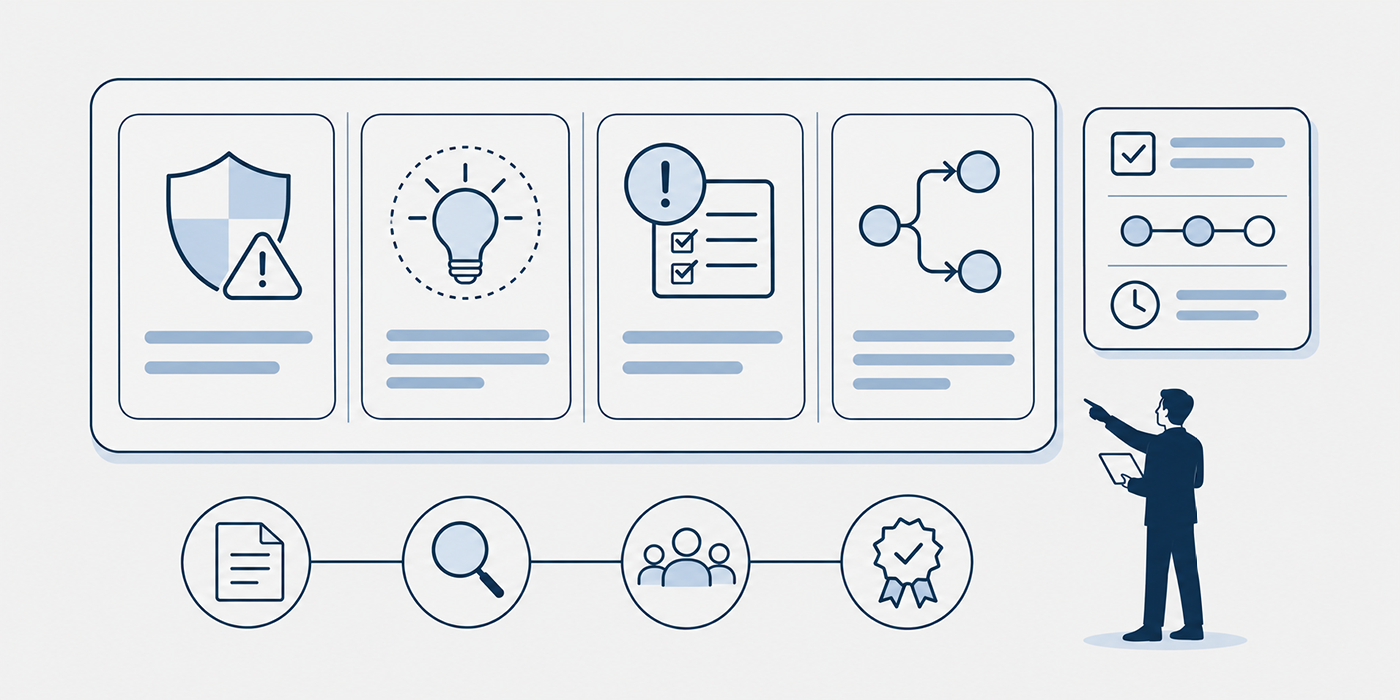
A RAID log is a centralized project control document that tracks four categories: Risks, Assumptions, Issues, and Dependencies. Each category represents a different threat to successful delivery and demands a specific management response.
The distinction matters because organizations frequently treat every project concern as a generic risk. This creates misleading project status reports, weakens accountability structures, and allows urgent problems to remain buried inside governance documentation.
Risks: What Might Go Wrong?
A risk is an uncertain future event that could affect project objectives. A useful risk statement explains its cause, possible occurrence, and consequence.
For example, a CRM migration project might face this risk: If the software vendor restricts API throughput during migration, the transfer could exceed the approved cutover window, delaying customer access.
The entry should identify probability, impact, early-warning indicators, response strategy, accountable owner, and a contingency trigger. Teams can strengthen these assessments using predictive project analytics, while potential cost consequences should feed into earned value and forecasting calculations.
For security-sensitive projects, cybersecurity risk controls may also impose mandatory escalation regardless of the numerical score.
Assumptions: What Are We Treating as True Without Proof?
An assumption is a planning belief that has not yet been sufficiently validated.
Suppose the project schedule assumes the legal department can approve a data-sharing agreement within three working days. That assumption becomes dangerous when nobody confirms reviewer availability or the actual approval process.
An effective assumption entry identifies the belief, its evidence requirement, validation owner, deadline, and consequence if false.
This approach is particularly important in business analysis and requirements management, where undocumented assumptions can distort estimates, acceptance criteria, and scope decisions. It also supports stage-gate project governance by forcing verification before irreversible commitments.
Issues: What Has Already Gone Wrong?
An issue is a problem that has occurred and requires resolution.
For example, if migration testing stops because staging credentials have expired, the problem belongs in the issue register immediately.
Its record needs the actual business impact, recovery action, decision authority, responsible owner, deadline, and evidence required to verify the fix.
Where delays affect approved milestones, connect the issue to schedule and cost performance analysis. Where resolution requires executive approval, use the established project governance escalation process.
An important distinction is that an issue can be marked resolved when a fix has been delivered, but it should only be closed after the designated receiving party verifies that the fix works.
Dependencies: What Must Someone Else Deliver First?
A dependency is an activity, approval, deliverable, or decision that another party must complete before the receiving work can progress.
For example, the integration team may need security to rotate production credentials before load testing can begin.
A dependency record should identify both the providing and receiving parties, the committed handoff date, the latest acceptable date, acceptance criteria, and the escalation owner.
This is where a RACI responsibility matrix becomes particularly useful. For technically complex projects, API and integration management provides additional mechanisms for documenting interface ownership and technical acceptance.
In larger initiatives, unresolved cross-project dependencies often require program-level coordination because a single supplier delay can affect several delivery teams simultaneously.
The Classification Rule That Prevents Duplicate Tracking
Ask four questions whenever a new concern appears:
Has the problem already happened? Record an issue.
Could the event happen in the future? Record a risk.
Does the plan rely on an unverified belief? Record an assumption.
Does progress require another party's output? Record a dependency.
A single situation may generate linked records across multiple categories. Keep their unique IDs and establish the relationships rather than copying identical descriptions.
This preserves traceability for PMO oversight, improves the reliability of AI-supported project reporting, and makes executive decision-making more actionable.
| RAID ID | Risk, Assumption, Issue or Dependency | Business Impact / Evidence | Required Action | Owner / Status |
|---|---|---|---|---|
| R-01 · Risk | CRM API throttling could exceed the six-hour migration window. | Customer downtime, delayed launch and potential rollback. | Load-test throughput; prepare incremental migration. | Integration Lead Open |
| R-02 · Risk | Customer personal data could appear in nonproduction logs. | Privacy, contractual and security exposure. | Mask sensitive fields, restrict logging and verify controls. | Security Lead Mitigating |
| R-03 · Risk | Legacy customer addresses may fail new validation rules. | Rejected records and incomplete migration. | Profile sample records and prepare cleansing rules. | Data Lead Open |
| R-04 · Risk | Legacy-system vendor may miss the export deadline. | Migration rehearsal and testing could be delayed. | Secure written delivery commitment and contingency extract. | Vendor Manager Open |
| R-05 · Risk | Support ticket volumes may exceed launch staffing. | Longer resolution times and customer dissatisfaction. | Forecast demand, train backup agents and prepare response scripts. | Service Lead Open |
| R-06 · Risk | Cloud transfer expenses may exceed the budget estimate. | Cost overrun and reduced contingency. | Model data-transfer volumes and establish cost alerts. | Finance Lead Open |
| R-07 · Risk | Rollback may exceed the approved outage tolerance. | Extended operational disruption. | Rehearse restoration and validate the rollback acceptance gate. | Release Lead Mitigating |
| A-01 · Assumption | Legal can approve the data agreement within three business days. | Unconfirmed review capacity threatens vendor access. | Obtain named reviewer and written turnaround commitment. | Legal Liaison Unvalidated |
| A-02 · Assumption | Migration volume will remain below 1.8 million active records. | Incorrect volume would invalidate throughput estimates. | Reconcile source-system counts with export totals. | Data Lead Unvalidated |
| A-03 · Assumption | Business testers will attend both acceptance-testing cycles. | Unavailable testers could delay sign-off. | Confirm calendars and nominate delegated approvers. | Business Lead Unvalidated |
| A-04 · Assumption | Staging permissions are equivalent to production permissions. | Testing revealed revoked credentials and access differences. | Mark assumption invalid and link to issue I-02. | Platform Lead Invalid |
| A-05 · Assumption | Every source field has an agreed business definition. | Unmapped fields may cause incorrect data transformation. | Audit field dictionary and obtain mapping approval. | Business Analyst Unvalidated |
| A-06 · Assumption | Existing purchase order covers additional vendor support. | Unapproved support hours may require new funding. | Verify purchase order and contract scope. | Procurement Lead Unvalidated |
| A-07 · Assumption | Pilot customer sample represents all important segments. | Missing segments could conceal launch defects. | Validate segment coverage against the full customer population. | QA Lead Unvalidated |
| I-01 · Issue | 12% of sampled contacts contain duplicate identifiers. | Confirmed data-quality failure affecting migration accuracy. | Approve deduplication rules and rerun reconciliation tests. | Data Lead In Progress |
| I-02 · Issue | Revoked staging credentials are blocking integration tests. | Authentication failures have stopped the test schedule. | Restore access and verify permissions through passing tests. | Platform Lead Escalated |
| I-03 · Issue | Acceptance tests show a 15% balance mismatch. | Financial reconciliation fails acceptance criteria. | Trace transformation logic and verify corrected balances. | QA Lead In Progress |
| I-04 · Issue | Two critical financial fields lack approved mapping owners. | Final ETL configuration cannot be accepted. | Assign accountable decision-maker and obtain field approval. | Finance Sponsor Escalated |
| I-05 · Issue | Unsigned data-processing addendum blocks vendor test access. | Contractual approval requirement remains incomplete. | Secure signature before releasing vendor access. | Legal Liaison Escalated |
| I-06 · Issue | Migration rehearsal achieves only 150,000 records per hour. | Projected duration is 12 hours versus a six-hour window. | Tune processing batches and repeat representative load test. | Integration Lead In Progress |
| I-07 · Issue | Business acceptance sign-off is two working days overdue. | Release decision gate is blocked. | Obtain authorized sign-off or approved recovery decision. | Business Lead Escalated |
| D-01 · Dependency | Legal approval must precede vendor test access. | Signed agreement and access authorization required. | Obtain approval and confirm receiving-team acceptance. | Legal Liaison Blocked |
| D-02 · Dependency | Vendor must deliver the complete legacy data export. | Migration rehearsal requires verified source files. | Receive file manifest, checksum and data-lead acceptance. | Vendor Manager At Risk |
| D-03 · Dependency | Security must rotate service-account credentials. | Integration load testing requires restored access. | Complete rotation and verify connection test. | Security Lead In Progress |
| D-04 · Dependency | Finance must approve account-field mapping. | Final ETL configuration depends on approved definitions. | Resolve disputed mappings and obtain formal acceptance. | Finance Sponsor Blocked |
| D-05 · Dependency | IT operations must approve the production deployment window. | Cutover requires approved change and rollback slots. | Confirm window and document change-control approval. | Release Lead At Risk |
| D-06 · Dependency | Support team must approve launch response procedures. | Go-live readiness requires training and support coverage. | Complete walkthrough and obtain service-lead acceptance. | Service Lead In Progress |
| D-07 · Dependency | Executive sponsor must approve the final go/no-go decision. | Deployment cannot proceed without authorized release approval. | Submit decision pack and record signed authorization. | Project Manager Pending |
2. How to Build a RAID Log Template That Teams Can Actually Use
The 28-entry example above models a fictional 12-week CRM migration. Its most important feature is the connection between records. A security approval can be a dependency, a missing signature can be an issue, and a possible release delay can be a risk. Together, they explain what is threatening delivery, who must act, and what decision is needed.
Start with a single master register. A spreadsheet works well for smaller projects, while larger teams may connect RAID entries to existing project management tools and standardized delivery templates. Maintain stable IDs so PMO reporting can consolidate exceptions without creating conflicting records.
The 14 Essential Fields in a Professional RAID Log
A robust RAID log should capture:
Unique ID: A permanent identifier such as R-001, A-001, I-001, or D-001.
Category: Risk, assumption, issue, or dependency.
Date identified: When the item was first recorded.
Description: The specific condition, event, or missing input.
Workstream: The activity, department, or deliverable affected.
Probability: Likelihood of occurrence, where applicable.
Impact: Consequence for cost, schedule, scope, quality, or compliance.
Priority: A rating derived from exposure and organizational thresholds.
Accountable owner: One named individual responsible for progress.
Next action: A measurable activity that can be verified.
Target date: When the action or required decision must happen.
Status: Current state using a defined category-specific workflow.
Linked IDs: Related risks, assumptions, issues, or dependencies.
Evidence and decision reference: The artifact proving what changed.
These fields provide enough detail for requirements traceability, responsibility allocation, and project governance reporting. Projects involving multiple contractors should also identify the dependency provider and receiving party explicitly.
How to Calculate RAID Risk Priority
For risks, a basic scoring method multiplies probability by impact, each rated from 1 to 5.
Risk score = Probability × Impact
For example, a vendor integration failure assessed at probability 4 and impact 5 receives a score of 20 out of 25.
An organization could adopt these illustrative thresholds:
1–4: Low. Assign an owner and review periodically.
5–9: Moderate. Define preventive action and monitor indicators.
10–15: High. Track mitigation progress at each control review.
16–25: Critical. Escalate according to the approved decision process.
Define the meaning of each probability and impact level before scoring. Otherwise, one stakeholder's level 4 may represent a 40% likelihood while another's represents 80%, making comparisons unreliable.
For risks with measurable financial exposure, consider expected monetary value = probability × financial consequence. A 30% chance of an $80,000 loss produces an expected exposure of $24,000, before accounting for secondary effects. Combine this with cost forecasting and earned value management where reliable data exists.
Some risks require immediate attention regardless of their score. Cybersecurity breaches, safety incidents, regulatory failures, and serious contractual exposure may trigger mandatory procedures under the organization's security management framework.
Apply Different Status Rules to Each Category
A common mistake is forcing every RAID entry into the same Open, In Progress, Closed workflow.
Use these category-specific states:
Risks: Open → Mitigating → Monitoring → Closed, with a linked issue created if the event occurs.
Assumptions: Unvalidated → Validated, Invalid, or Superseded.
Issues: Open → In Progress → Resolved → Verified → Closed.
Dependencies: Pending → Confirmed → Delivered → Accepted, with Blocked and At Risk as exception states.
For example, marking a dependency Delivered simply means the supplier has provided it. The receiving team may still reject the deliverable because it fails technical acceptance criteria.
That distinction matters in software integration workflows, Agile delivery coordination, and cross-functional governance.
Write Actions With Clear Completion Tests
Weak RAID action: Follow up with the vendor.
Stronger RAID action: Obtain the complete source export by November 24, verify its checksum, and secure data-lead acceptance before scheduling the full migration rehearsal.
The stronger version identifies the deliverable, timing, verification condition, and receiving authority.
Apply this language consistently to project documentation, business analysis deliverables, consulting assignments, and executive reporting.
A well-written RAID action should make it possible for an independent reviewer to determine whether the promised outcome was achieved.
3. Worked RAID Log Example: How One Problem Moves Through All Four Categories
Consider the CRM migration scenario. The organization is transferring approximately 1.8 million customer records into a new platform, with a six-hour deployment window and a final executive go/no-go decision.
Initially, the project plan assumes staging access mirrors production permissions. This assumption appears as A-04.
During testing, staging credentials are found to be revoked. The assumption is now invalid, and an active issue, I-02, prevents integration testing.
The project also depends on security completing credential rotation, tracked as D-03. Meanwhile, R-01 warns that API throughput limitations could cause the migration to overrun the approved deployment window.
The four entries are interconnected, but each requires distinct evidence and actions. Linking them helps maintain integration accountability, cybersecurity oversight, delivery forecasts, and project governance controls.
Step 1: Record the Invalid Assumption Without Erasing History
Mark A-04 as Invalid, attach the failed permissions test, and link issue I-02.
The original assumption should remain available because it explains why the project underestimated the access requirement. This is valuable during business-analysis reviews, PMO assurance, and post-project performance analysis.
The platform lead should document the permission gap and obtain a verified restoration date. If the delay threatens an approved milestone, it must enter the formal escalation process.
Step 2: Recover the Issue and Confirm the Dependency
Issue I-02 requires restoring access and successfully repeating the authentication tests.
Dependency D-03 requires the security team to complete credential rotation and the integration team to accept the resulting configuration.
A completed security ticket alone does not prove that the integration works. The receiving team must execute a valid connection test.
This two-sided acceptance discipline reduces problems caused by incomplete technical handoffs and unclear responsibility assignments. It also provides the evidence required for reliable automated project reporting.
Step 3: Quantify the Actual Schedule Exposure
Suppose 1.8 million records must be migrated within six hours.
The required average throughput is:
1,800,000 ÷ 6 = 300,000 records per hour.
Now suppose the rehearsal achieves only 150,000 records per hour.
The projected processing duration becomes:
1,800,000 ÷ 150,000 = 12 hours.
That implies a six-hour overrun before accounting for post-migration validation, reconciliation, and rollback contingency.
The RAID log must now connect I-06, the failed throughput rehearsal, to R-01, the potential cutover overrun.
This gives the project manager a measurable basis for schedule forecasting, baseline variance analysis, and sponsor escalation.
Step 4: Present a Decision With Cost and Schedule Consequences
The sponsor needs feasible alternatives, each accompanied by its trade-offs.
Option A: Incremental preloading. Transfer eligible records before cutover, leaving only the final changes for the deployment window. This requires data-integrity controls and approval of the preload approach.
Option B: Additional migration capacity. Increase parallel processing where API limits, infrastructure capacity, and vendor terms permit. Validate the resulting throughput with a representative test.
Option C: Rescheduled deployment. Extend testing and move the cutover after obtaining the required stakeholder approvals.
The decision record should state the selected option, approving authority, forecast impact, assumptions, and new acceptance criteria.
For major programs, these options should also appear in program-level coordination, project cost forecasts, and executive governance reporting.
Step 5: Close Each Record Against Its Own Evidence
After recovery, close the linked records according to their individual completion criteria.
A-04 remains documented as an invalidated assumption. I-02 closes after the access fix is independently verified. D-03 closes after the integration team accepts the rotated credentials. R-01 closes only when the project has passed the exposure period or residual risk has been addressed under the agreed closure policy.
For teams using Agile project delivery, PMO controls, or formal project governance, this lifecycle creates a traceable history from the initial warning through resolution and acceptance.
4. How to Run a RAID Log Review Meeting That Produces Real Decisions
The value of a RAID log depends on how quickly its information changes project decisions. A spreadsheet containing 50 concerns offers limited protection when the team reviews them after the delivery dates have already passed.
An effective review process prioritizes exceptions, tests evidence, assigns decisions, and updates the project forecast. This discipline belongs within the organization's project governance framework and should align with existing PMO reporting practices, responsibility assignments, and performance monitoring.
Establish a Risk-Based Review Frequency
Use the project's risk exposure to determine how often records require attention.
For a stable project, a weekly RAID review may be sufficient. During a critical release, contract negotiation, deployment, or regulatory approval period, high-priority records may require daily monitoring.
A practical 30-minute review agenda is:
Minutes 0–5: Identify newly reported critical issues and breached deadlines.
Minutes 5–10: Review dependencies affecting upcoming milestones.
Minutes 10–15: Examine high-consequence assumptions awaiting validation.
Minutes 15–22: Assess material risks and the effectiveness of mitigation actions.
Minutes 22–27: Obtain decisions, confirm escalations, and agree recovery measures.
Minutes 27–30: Assign actions, deadlines, and evidence requirements.
This approach reduces meeting overhead while strengthening Agile team coordination, program delivery oversight, and stakeholder reporting.
Escalate Problems Before They Become Irrecoverable
A useful escalation policy combines severity with the time remaining before the affected milestone.
For example, an organization might establish these operating thresholds:
Critical issue: Notify the designated authority immediately when security, compliance, safety, or a committed go-live is threatened.
High-priority issue: Obtain an owner-approved recovery plan by the next working-day review.
Critical-path dependency: Escalate when its forecast delivery exceeds the latest acceptable handoff date, even if the supplier's original due date has not passed.
Invalid assumption: Assess the consequences immediately when the invalidated belief affects approved scope, cost, schedule, or acceptance criteria.
These thresholds should be tailored to contractual obligations and organizational risk governance requirements. Security-related exceptions may require additional controls from cybersecurity project management.
Give Executives a Decision, a Deadline, and a Consequence
Consider this example:
I-06: Migration throughput is 150,000 records per hour against a minimum theoretical requirement of 300,000. The six-hour deployment window is threatened. Approval is requested for an incremental preload approach before the next rehearsal.
A decision-ready escalation should identify the current variance, business impact, proposed response, approval authority, and latest safe decision date.
Senior leaders can then evaluate the trade-offs using project cost estimates, forecasting techniques, and executive governance procedures.
Record Decisions Separately From Action Updates
A RAID log tracks the condition requiring intervention. A linked decision record preserves the rationale behind the selected response.
For consequential decisions, capture the approving authority, options considered, constraints, decision date, affected baseline, and any conditions attached to approval.
This protects organizations against recurring disputes when stakeholders change, suppliers challenge requirements, or previously approved solutions produce unexpected outcomes.
It also creates stronger evidence for project management consultants, portfolio governance leaders, and professionals progressing toward senior project leadership.
A successful RAID review ends with verified ownership, clear decisions, and updated forecasts. Every unresolved critical entry should leave the meeting with a defined next action and decision deadline.

5. How to Improve RAID Log Quality, Automation, and Project Visibility
A mature RAID process makes emerging delivery problems visible across planning, execution, and governance systems. Its effectiveness depends on information quality, ownership discipline, and early-warning capability.
Connect RAID Records to Your Existing Project Controls
Use consistent identifiers to connect:
Risks to mitigation plans and contingency triggers.
Assumptions to requirements, planning estimates, and validation evidence.
Issues to incident records, corrective actions, and baseline variances.
Dependencies to schedule activities, suppliers, receiving teams, and acceptance conditions.
This integration reduces the need to update multiple registers manually. Organizations can build these connections through project management APIs and standardize fields using project management resources.
For Agile organizations, retain delivery tickets for routine sprint-level work while using RAID to monitor cross-team blockers, external commitments, and business-level decisions. This distinction improves scaled Agile coordination, Scrum@Scale implementation, and traditional-to-Agile project transitions.
Measure the Three Indicators That Reveal Weak RAID Management
1. Overdue action rate
Calculate the number of overdue open RAID actions divided by the total number of open actions with due dates.
For example, if 12 of 40 open actions are overdue, the overdue action rate is 30%.
Track the trend and identify the owners or workstreams responsible for persistent delays.
2. Unvalidated critical-assumption exposure
Count high-consequence assumptions that lack adequate supporting evidence.
This is particularly valuable before procurement commitments, deployment approvals, regulatory submissions, and major design decisions.
Connect high-impact assumptions to business analysis validation and governance decision gates.
3. Blocked critical-path dependencies
Count dependencies whose missing outputs can delay committed project milestones.
Unlike a general overdue-action count, this measure exposes direct threats to schedule completion.
Use it alongside schedule performance indicators and predictive project analytics to distinguish administrative lateness from genuine delivery exposure.
Eliminate Five Common RAID Log Failures
Failure 1: Assigning ownership to a department.
An entry assigned to "IT" or "Operations" lacks individual accountability. Assign one named responsible person and define approval authority using a RACI matrix.
Failure 2: Treating every concern as high priority.
When every entry is critical, decision-makers lose the ability to distinguish material threats. Calibrate thresholds against actual project objectives, contractual exposure, and the consequences reflected in financial performance indicators.
Failure 3: Using vague mitigation actions.
Instructions such as "monitor situation" or "discuss with supplier" rarely create measurable progress. Replace them with deliverable-based actions and specific acceptance criteria developed through requirements management practices.
Failure 4: Closing issues without independent verification.
A defect can reappear if the fix was never tested by its receiving owner. Connect closure to technical evidence, stakeholder acceptance, and the appropriate delivery integration workflow.
Failure 5: Reporting outdated information to leadership.
A RAID log updated immediately before a steering committee may already contain expired assumptions and obsolete forecasts. Automate reminders where practical, preserve original update timestamps, and use AI-assisted reporting to prepare summaries for human verification.
Make RAID Logs Audit-Ready
Before distributing a RAID report, verify that every open critical record has an accountable owner, current impact assessment, next measurable action, due date, and escalation route.
Every assumption should have a validation result or deadline. Every dependency should identify the provider and receiving party. Every resolved issue should carry evidence that the correction was verified.
These controls strengthen PMO assurance practices, improve consulting-quality delivery documentation, and provide reliable evidence for executive project reviews.
For recurring projects, preserve the final RAID register as an input to future estimating, supplier evaluation, and planning. Repeated invalid assumptions and missed dependencies can reveal systemic weaknesses that a single project's closure report would otherwise conceal.
6. Frequently Asked Questions About RAID Logs
-
A risk register focuses on uncertainty that could affect project outcomes. It typically includes likelihood, consequence, mitigation, contingency, residual exposure, and response ownership.
A RAID log provides a broader management view by connecting risks with assumptions, existing issues, and dependencies.
For complex initiatives, maintain detailed risk assessments separately and reference their IDs in the RAID log. This preserves the depth needed for risk evaluation and project planning while giving governance leaders an integrated view of delivery threats.
Use financial forecasting and predictive analysis to quantify material risks when reliable evidence is available.
-
Small projects benefit from a lightweight RAID process when they involve meaningful uncertainty, external approvals, or cross-team commitments.
A two-week sprint might require only a few actively monitored entries, while a short regulatory implementation can demand extensive evidence and formal approvals.
The appropriate control level depends on the project's complexity and consequences.
In Agile project management, teams can manage ordinary impediments in the delivery board and reserve RAID entries for issues requiring broader coordination. This approach supports scaled Agile delivery, cross-team responsibility assignments, and software workflow integration.
-
Yes. The records represent different states or consequences.
Suppose a vendor's API limitations create the possibility of a migration delay. Initially, the concern is a risk.
When a rehearsal fails because throughput is inadequate, that failure becomes an issue. The future deployment overrun may remain a separate risk.
Keep the original risk identifier, record the actual occurrence date, create the issue record, and link both entries.
This preserves historical information needed for forecast calibration, schedule variance analysis, PMO oversight, and automated project reporting.
-
The project manager usually maintains the master register, ensures regular review, and coordinates escalations.
Each individual RAID entry should have an accountable owner with the authority or access necessary to advance its next action.
For example, a project manager may monitor legal approval, but the authorized legal representative must own the approval itself.
This separation should be reflected in the project's RACI assignments.
Large initiatives may use program managers to coordinate shared dependencies, PMO leaders to establish reporting standards, and executive sponsors to approve decisions outside the project manager's authority.
-
Assumptions and dependencies require different evaluation criteria from uncertain risks.
For assumptions, prioritize the consequence of being wrong, the strength of available evidence, and how soon the belief affects an irreversible decision.
For dependencies, assess the latest acceptable delivery date, schedule criticality, reliability of the provider's commitment, and available alternatives.
A critical-path dependency with zero remaining float may warrant immediate escalation even when its promised date has not passed.
Connect this analysis to schedule performance management, predictive scheduling, requirements validation, and project governance decisions.
-
Update entries whenever significant facts change, with formal review frequency determined by the project phase and exposure level.
Weekly reviews may be appropriate for stable work. Daily reviews may be necessary during production releases, regulatory deadlines, major procurements, and recovery periods.
Critical incidents should follow the applicable notification and escalation procedures immediately.
The operating cadence should align with Agile delivery practices, PMO governance requirements, and stakeholder decision cycles.
Where possible, use project management integrations to flag overdue actions and approaching validation deadlines.
